Which Micropipette Is the Most Accurate? Complete Guide to Accuracy, Precision & Selection


When laboratory results depend on the accurate transfer of very small liquid volumes, choosing the right micropipette is essential. A difference of only a few microlitres can influence dilution ratios, reagent concentrations, PCR preparation, ELISA results, pharmaceutical testing, diagnostic procedures and research outcomes.
So, which micropipette is the most accurate?
The answer is not simply one particular model or brand. The most accurate micropipette for a specific application is the one that is correctly matched to the required volume, liquid type, pipette range, compatible tip, operating technique and calibration requirements.
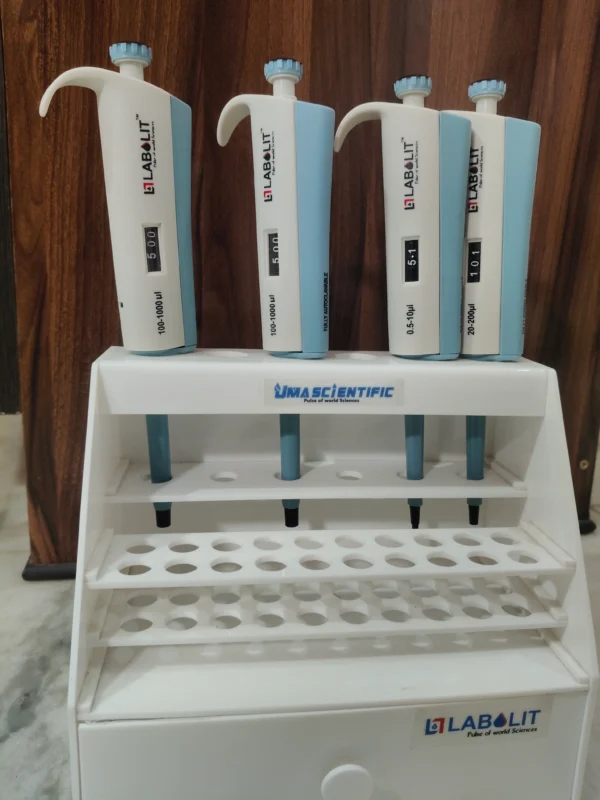
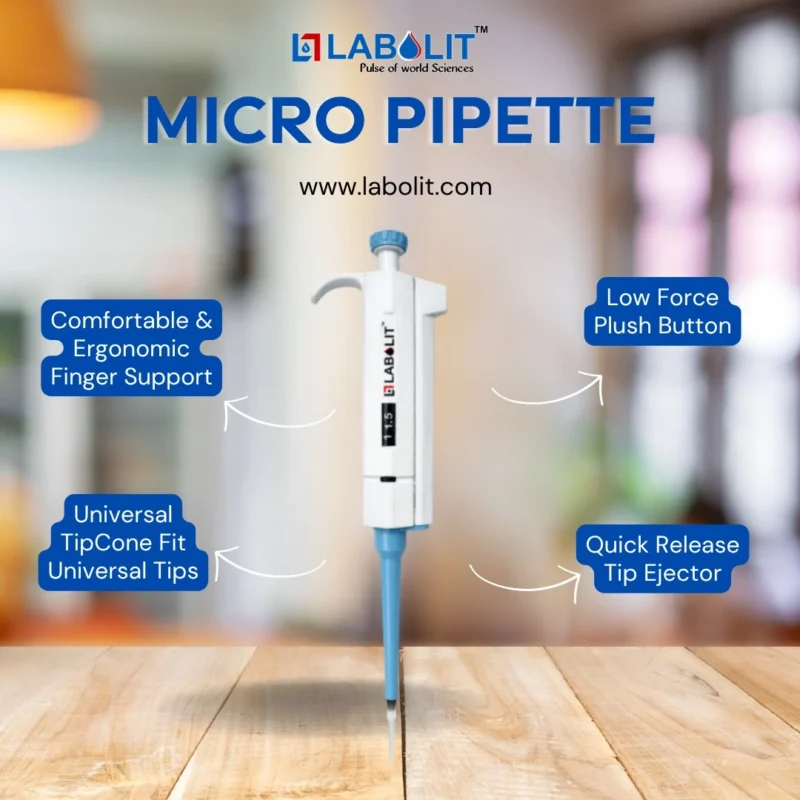
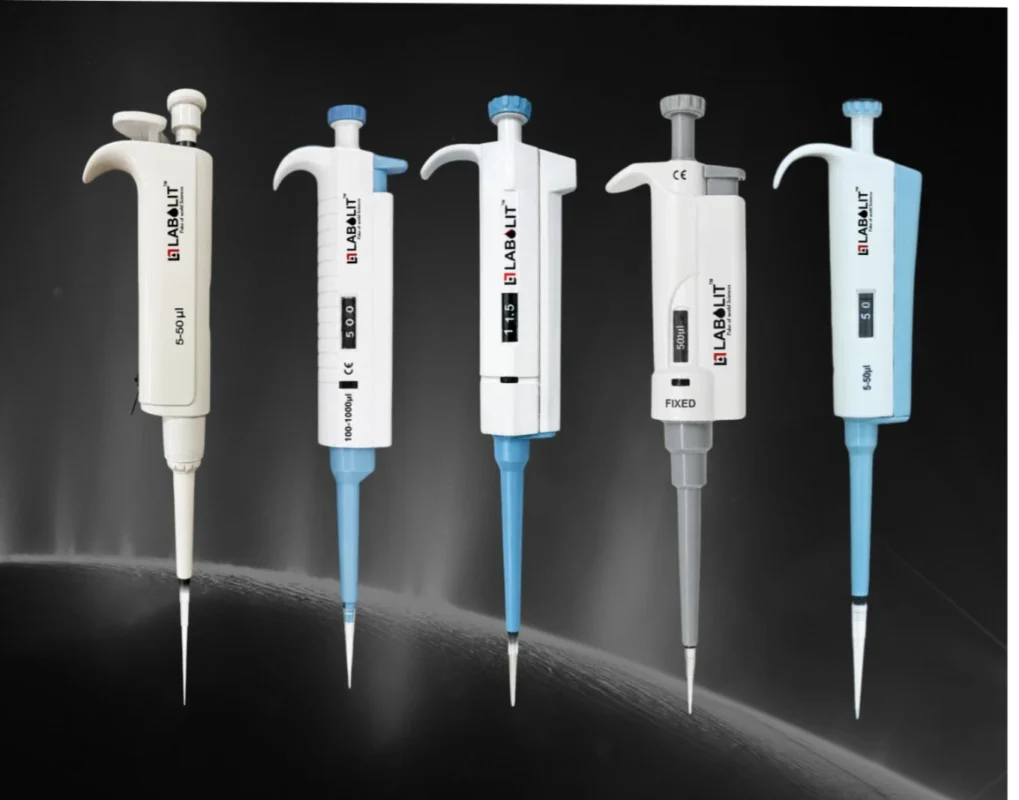
At LABOLIT, we manufacture and supply precision micropipettes designed for laboratories requiring dependable, repeatable and accurate liquid handling. Our range includes single-channel, multichannel, fixed-volume, variable-volume and mini micropipettes for applications across research, biotechnology, pharmaceuticals, diagnostics, healthcare, education and industrial laboratories.
What Is Micropipette Accuracy?

Micropipette accuracy refers to how closely the actual volume delivered by a pipette corresponds to the selected or intended volume.
For example, if a micropipette is set to dispense 100 µL, its accuracy relates to how close the actual delivered volume is to 100 µL under specified testing conditions.
Accuracy is particularly important when:
- Preparing reagents
- Performing serial dilutions
- Preparing PCR reactions
- Conducting ELISA testing
- Performing molecular biology experiments
- Preparing pharmaceutical samples
- Conducting diagnostic tests
- Handling expensive reagents
- Working with low-volume samples
A small volume error can become more significant when the liquid is subsequently diluted or used in a sensitive analytical procedure.
Accuracy vs Precision: What Is the Difference?
Accuracy and precision are related but are not the same.
Accuracy
Accuracy describes how close the measured or delivered volume is to the intended value.
Precision
Precision describes how consistently a micropipette delivers the same volume during repeated operations.
For example, a pipette may deliver:
- 99.8 µL
- 99.9 µL
- 99.8 µL
- 99.9 µL
This indicates excellent repeatability.
However, if the intended volume is 100 µL and the pipette consistently delivers a lower volume, it may demonstrate good precision but not ideal accuracy.
Therefore, laboratories should consider both accuracy and precision when selecting a micropipette.
Which Micropipette Is the Most Accurate?

There is no single micropipette that is automatically the most accurate for every laboratory application.
The best-performing micropipette depends on several factors:
- Required liquid volume
- Pipette volume range
- Liquid characteristics
- Pipette tip quality
- Pipetting technique
- Calibration
- Temperature and environmental conditions
- Maintenance
- Operator experience
- Application requirements
For general laboratory applications, a high-quality variable-volume single-channel micropipette is often a highly versatile choice.
For microplates and high-throughput applications, an 8-channel or 12-channel micropipette can provide efficient and consistent liquid transfer across multiple wells.
For specialised liquids, the appropriate pipetting technology may differ.
The important principle is:
Choose the micropipette according to the actual volume and application—not simply according to the maximum volume printed on the pipette.
Why the Micropipette Volume Range Matters
One of the most important factors in selecting an accurate micropipette is the volume range.
For example, suppose a laboratory regularly needs to transfer 20 µL.
Using a pipette designed for a range such as 2–20 µL is generally more appropriate than selecting a much larger pipette and operating it near the bottom of its range.
Likewise, if the required volume is 500 µL, a pipette designed for that working range is preferable to selecting a pipette intended primarily for very small volumes.
This is why professional laboratories often maintain several micropipettes covering different volume ranges.
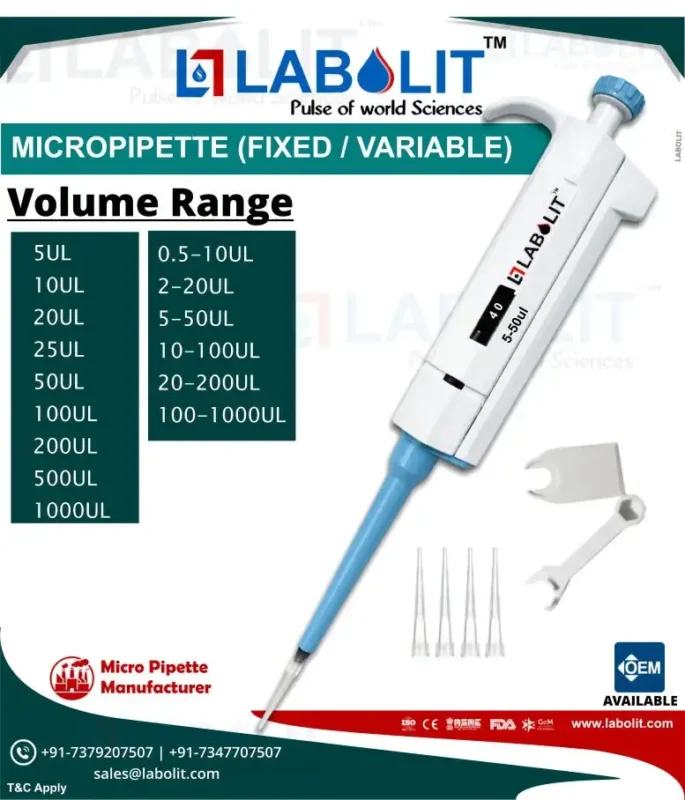
Typical laboratory volume ranges include:
- 0.1–2 µL
- 0.5–10 µL
- 2–20 µL
- 5–50 µL
- 10–100 µL
- 20–200 µL
- 100–1000 µL
- 1000–5000 µL
- Up to 10,000 µL for selected liquid-handling applications
The correct range allows the operator to select a pipette that is better suited to the volume being transferred.
LABOLIT Micropipettes for Accurate Liquid Handling
LABOLIT provides a broad range of micropipettes for laboratories requiring reliable liquid handling.
Our micropipette range includes:
LABOLIT Single-Channel Micropipettes
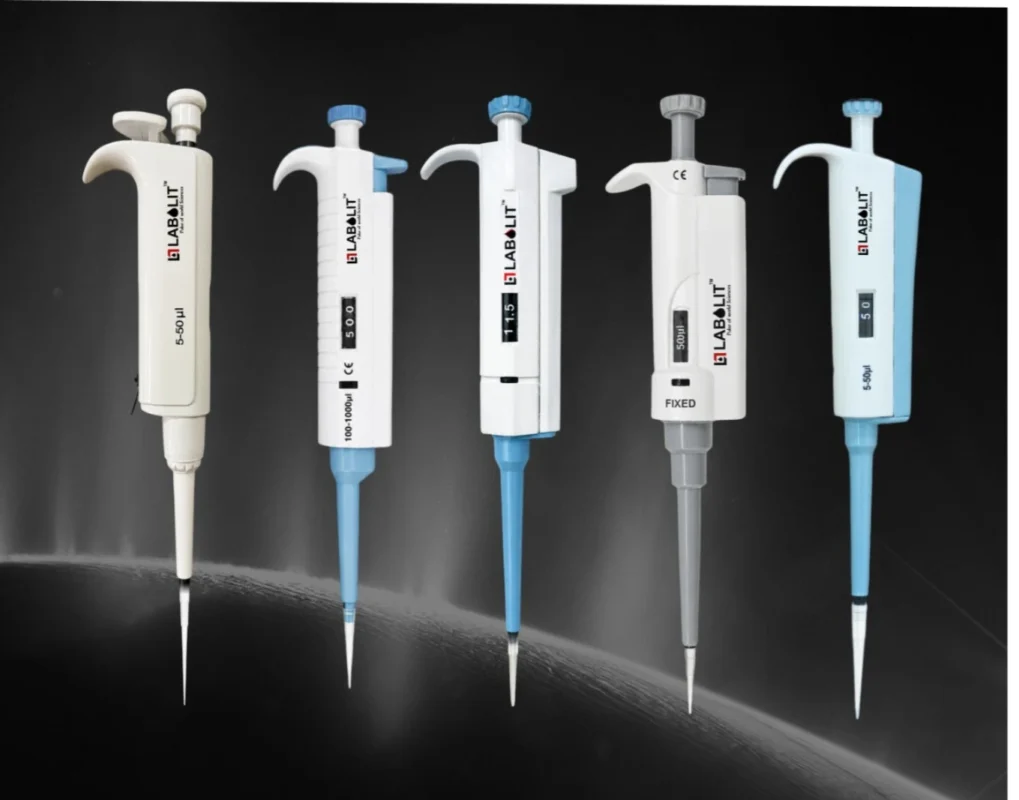
Single-channel micropipettes are suitable for individual sample handling and routine laboratory applications.
They are commonly used in:
- Molecular biology
- Microbiology
- Biochemistry
- Pharmaceutical laboratories
- Diagnostic laboratories
- Research laboratories
- Educational institutions
- Quality-control laboratories
LABOLIT single-channel micropipettes are available in multiple volume ranges to help laboratories select the appropriate instrument for their application.
LABOLIT UM-PRO Micropipette
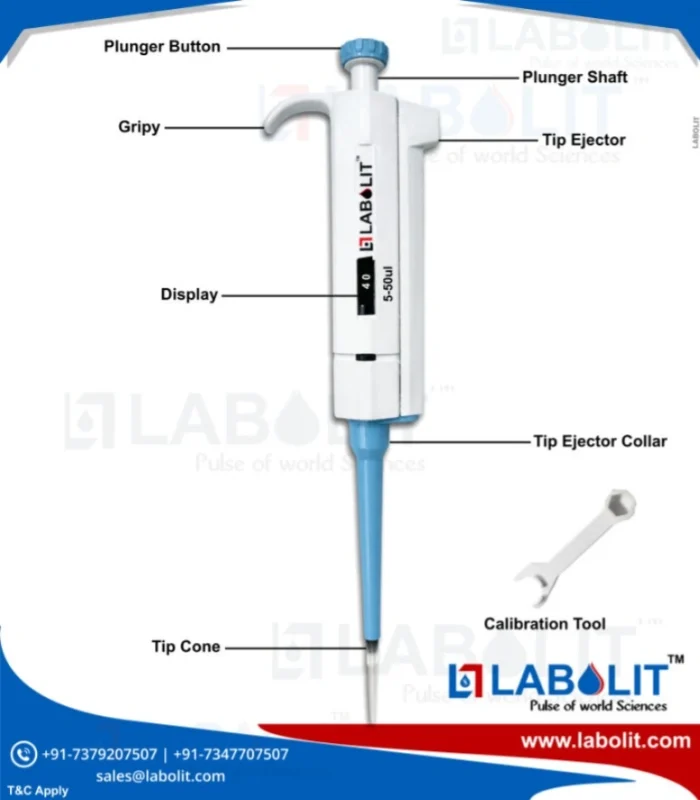
The LABOLIT UM-PRO is a variable-volume micropipette range designed for precision liquid handling.
The range covers multiple capacities, including small-volume and larger-volume configurations.
The LABOLIT UM-PRO product range features:
- Variable-volume operation
- Easy volume adjustment
- Click-stop volume setting
- Ergonomic construction
- Smooth plunger operation
- Easy calibration and servicing
- Autoclavable lower assembly on applicable models
- Tip-ejector system
- Reverse pipetting capability
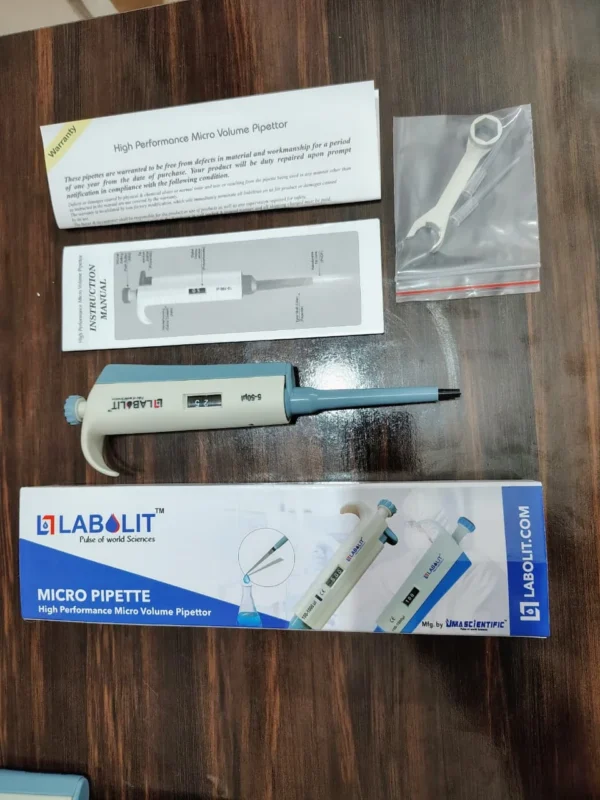
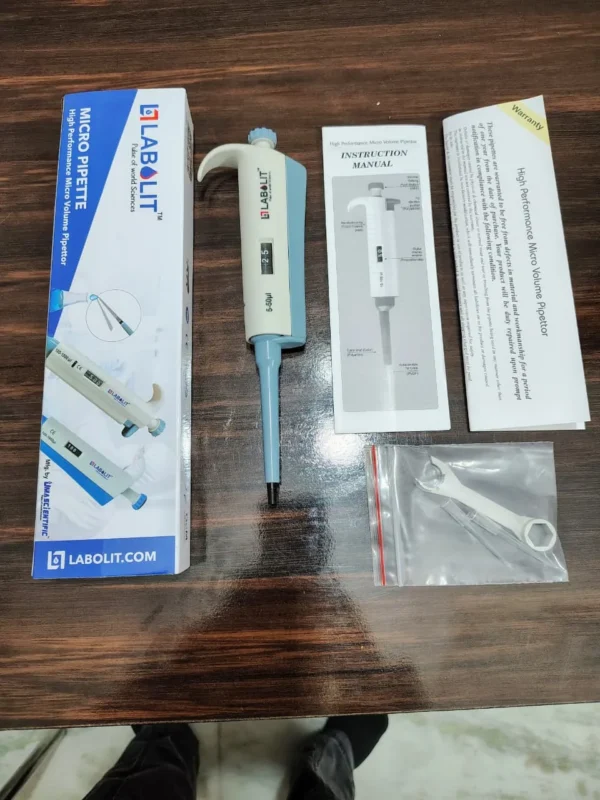
- Calibration report with product
- Accuracy and precision specifications for individual volume ranges
For example, LABOLIT lists a UM-PRO 0.5–10 µL configuration with a 0.1 µL increment and published inaccuracy/imprecision specifications. LABOLIT also provides multiple larger-volume configurations in the UM-PRO range.
This makes the UM-PRO family suitable for laboratories requiring different micropipette capacities within one product range.
Fixed-Volume Micropipettes
Fixed-volume micropipettes are designed to dispense a predetermined volume.
They are particularly useful when the same volume is repeatedly used during laboratory procedures.
Advantages include:
- Simple operation
- Consistent volume setting
- Fast repetitive pipetting
- Reduced volume-adjustment errors
- Suitable for routine laboratory workflows
Fixed-volume micropipettes can be particularly useful in laboratories where a standard procedure repeatedly requires the same volume.
Variable-Volume Micropipettes
Variable-volume micropipettes provide greater flexibility because the operator can select different volumes within the specified range.
For laboratories performing multiple experiments, this can reduce the number of pipettes required.
For example, a laboratory may use different volumes during:
- Sample preparation
- Reagent preparation
- Serial dilution
- PCR setup
- DNA/RNA procedures
- ELISA preparation
- Microbiological testing
A properly selected variable-volume micropipette can therefore be a highly versatile laboratory instrument.
8-Channel and 12-Channel Micropipettes
For laboratories working with microplates, an individual single-channel pipette can become time-consuming.
This is where multichannel micropipettes provide an important advantage.
LABOLIT offers multichannel liquid-handling solutions for applications where multiple samples need to be transferred simultaneously.
Common applications include:
- ELISA
- PCR plate preparation
- Microplate assays
- Serial dilution
- Screening
- High-throughput research
- Molecular biology
- Diagnostic workflows
An 8-channel micropipette can transfer liquid into eight wells simultaneously, while a 12-channel configuration can handle twelve wells at once.
The result is improved workflow efficiency and reduced repetitive pipetting.
Is an 8-Channel Micropipette More Accurate Than a Single-Channel Pipette?
Not necessarily.
The two instruments are designed for different workflows.
A single-channel micropipette provides individual sample control, while a multichannel pipette allows simultaneous liquid transfer across multiple wells.
For a multichannel pipette, it is important to consider:
- Channel-to-channel consistency
- Tip compatibility
- Proper tip fitting
- Consistent aspiration
- Correct immersion depth
- Plate alignment
- Operator technique
Therefore, the most suitable pipette depends on the application rather than simply choosing the instrument with the highest number of channels.
Why Pipette Tips Affect Accuracy
A micropipette and its tip should be considered together as a liquid-handling system.
Even a high-quality micropipette can perform poorly if the tip:
- Does not fit correctly
- Has inconsistent dimensions
- Is damaged
- Is incompatible with the pipette
- Allows air leakage
- Retains excessive liquid
- Is improperly attached
Using appropriate, compatible and good-quality pipette tips is therefore essential.
LABOLIT provides liquid-handling solutions and accessories designed to support reliable pipetting workflows.
How Pipetting Technique Affects Accuracy
A calibrated micropipette does not automatically guarantee accurate results in every user’s hands.
Operator technique can have a significant influence on actual liquid delivery.
Important factors include:
1. Correct pipette selection
Select a micropipette whose volume range is appropriate for the required volume.
2. Correct tip attachment
The tip should be securely and correctly fitted.
3. Proper aspiration speed
Liquid should be aspirated smoothly rather than with sudden movement.
4. Correct immersion depth
The tip should be immersed appropriately in the liquid.
5. Correct pipette angle
Maintaining a consistent position helps improve repeatability.
6. Controlled dispensing
Dispensing should be smooth and consistent.
7. Avoid air bubbles
Air bubbles can affect the actual liquid volume transferred.
8. Pre-wetting when appropriate
For certain applications, pre-wetting the tip can help improve consistency.
9. Reverse pipetting for appropriate liquids
Reverse pipetting can be useful for viscous, foaming or other challenging liquids when appropriate.
Micropipette Calibration: Why It Is So Important
Calibration is one of the most important factors in maintaining micropipette performance.
A pipette can gradually experience performance changes because of:
- Mechanical wear
- Contamination
- Leakage
- Damage
- Frequent use
- Improper cleaning
- Accidental impact
- Environmental changes
Regular calibration and verification help determine whether the actual delivered volume remains within the required performance limits.
ISO 8655 provides requirements and test methods for piston-operated volumetric apparatus. Modern calibration practices can include gravimetric and photometric approaches depending on the applicable standard and procedure.
LABOLIT micropipettes are designed for calibration and servicing, and applicable LABOLIT models are supplied with calibration documentation.
How Is Micropipette Accuracy Tested?
A common calibration approach is to determine the mass of water delivered by the pipette under controlled conditions and convert that measurement into volume.
Repeated measurements are then used to evaluate the performance of the pipette.
Important parameters include:
Systematic error
The difference between the average delivered volume and the target volume.
Random error
The variation between repeated measurements.
Repeatability
How consistently the pipette delivers the selected volume.
Measurement uncertainty
The uncertainty associated with the calibration measurement itself.
Professional calibration requires appropriate measurement equipment and controlled environmental conditions.
Temperature and Environment Also Matter
Micropipette performance can be influenced by environmental conditions.
Important factors include:
- Ambient temperature
- Liquid temperature
- Air pressure
- Humidity
- Liquid viscosity
- Vapour pressure
- Evaporation
This becomes particularly important when working with very small volumes.
Therefore, laboratories performing high-accuracy work should control their testing and operating environment as far as practical.
Air-Displacement Micropipettes
Air-displacement micropipettes are widely used in laboratories.
They work by moving a piston to create an air cushion between the piston and liquid. The resulting pressure difference allows the liquid to enter the pipette tip.
They are suitable for many aqueous laboratory applications.
LABOLIT offers air-displacement micropipette solutions across multiple volume ranges.
Positive-Displacement Pipetting
Certain liquids may require different pipetting approaches.
Viscous, volatile or high-vapour-pressure liquids can behave differently from water.
For these applications, positive-displacement technology may be more suitable because the piston directly interacts with the liquid rather than relying on an air cushion.
The important point is that no single pipetting technology is best for every liquid.
The correct technology should be selected according to the physical characteristics of the liquid and the requirements of the application.
How to Choose the Most Accurate LABOLIT Micropipette
Before purchasing a micropipette, consider the following checklist.
Volume
What volume do you normally transfer?
Range
Is the required volume comfortably within the pipette’s specified range?
Application
Are you working with PCR, ELISA, cell culture, diagnostics, pharmaceutical testing or general laboratory samples?
Channel configuration
Do you need single-channel, 8-channel or 12-channel operation?
Liquid type
Is the liquid aqueous, viscous, volatile, foaming or otherwise difficult to pipette?
Tips
Are compatible and appropriate-quality tips available?
Calibration
Can the micropipette be calibrated and serviced?
Ergonomics
Will the pipette remain comfortable during repetitive work?
Maintenance
Can the pipette be cleaned, maintained and serviced easily?
Warranty and technical support
Does the supplier provide appropriate after-sales assistance?
LABOLIT Micropipette Range
LABOLIT offers a comprehensive range of laboratory liquid-handling products, including:
- Single-channel micropipettes
- Variable-volume micropipettes
- Fixed-volume micropipettes
- 8-channel micropipettes
- 12-channel micropipettes
- Mini micropipettes
- Fully autoclavable micropipette models
- Semi-autoclavable micropipette models
- Pipette tips
- Pipette stands
- Bottle top dispensers
- Other laboratory liquid-handling solutions
The LABOLIT product range includes models such as:
UM-PRO | UM-PRIME | UM-ECO | UM-MAX | UM-ULTRA | UM-ULTRA4 | UM-LABPRO | UM-MULTI | UM-MINI
Different models and configurations are designed for different laboratory requirements.
Why Choose LABOLIT Micropipettes?
LABOLIT focuses on precision liquid handling and laboratory equipment for professional users.
Key advantages include:
Wide Volume Selection
Choose from multiple micropipette volume ranges for different applications.
Single and Multichannel Options
Suitable for individual sample handling as well as microplate workflows.
Ergonomic Operation
Designed for comfortable and controlled pipetting.
Calibration & Serviceability
Applicable LABOLIT micropipettes are designed for calibration and servicing.
Quality-Focused Manufacturing
LABOLIT focuses on consistent manufacturing and quality control.
Laboratory Applications
Suitable for pharmaceutical, biotechnology, diagnostic, research, healthcare, educational and industrial laboratories.
OEM & Bulk Supply
LABOLIT also supports bulk and OEM requirements for laboratory equipment and liquid-handling products.
Which LABOLIT Micropipette Should You Choose?
There is no universal answer because the correct micropipette depends on the required volume and application.
| Requirement | Recommended LABOLIT Solution |
|---|---|
| Individual sample handling | Single-channel micropipette |
| Multiple volume requirements | Variable-volume micropipette |
| Repetitive fixed volume | Fixed-volume micropipette |
| PCR/microplate workflow | 8-channel or 12-channel micropipette |
| Small-volume applications | Small-volume LABOLIT micropipette |
| Routine laboratory work | LABOLIT UM-PRO / suitable model |
| High-throughput liquid handling | LABOLIT multichannel solutions |
| Different laboratory applications | Multiple volume-range micropipettes |
Final Answer: Which Micropipette Is the Most Accurate?
The most accurate micropipette is not necessarily the most expensive pipette or the pipette with the largest specification.
The best choice is the micropipette that provides the required performance for your specific volume and application while being used with the correct tips, correct technique and appropriate calibration.
For general laboratory applications, a properly selected LABOLIT variable-volume single-channel micropipette can provide an excellent combination of flexibility, accuracy and repeatability.
For microplate-based applications, LABOLIT 8-channel and 12-channel micropipettes can improve productivity while supporting consistent liquid handling.
For repetitive applications, fixed-volume models can provide convenient operation.
For specialised liquids, the appropriate pipetting technology should be selected according to the liquid’s properties.
Ultimately:
Right Pipette + Right Volume Range + Right Tip + Right Technique + Regular Calibration = Reliable Pipetting
When accuracy matters, choose the micropipette according to your actual laboratory requirements.
Choose LABOLIT for precision liquid handling and professional laboratory solutions.
Frequently Asked Questions About Micropipette Accuracy
Which micropipette is the most accurate?
There is no single micropipette that is universally the most accurate. Accuracy depends on volume range, design, tips, calibration, liquid characteristics and operating technique.
Is LABOLIT micropipette accurate?
LABOLIT manufactures micropipettes with specified accuracy and precision characteristics for different volume ranges. Applicable LABOLIT models are supplied with calibration documentation and are designed for calibration and servicing.
Which is better: fixed or variable micropipette?
A fixed-volume micropipette is useful for repetitive work at one volume, while a variable-volume micropipette provides greater flexibility for laboratories handling multiple volumes.
Which micropipette is best for PCR?
For individual PCR preparation, a suitable single-channel micropipette can be used. For PCR plate preparation, an 8-channel or 12-channel micropipette can significantly improve workflow efficiency.
Which micropipette is best for ELISA?
Multichannel micropipettes are commonly preferred for microplate-based ELISA workflows because multiple wells can be handled simultaneously.
Does pipette calibration improve accuracy?
Calibration verifies the actual performance of a micropipette against the required volume and helps identify systematic or random errors. Regular calibration is particularly important for laboratories where volume accuracy is critical.
Do pipette tips affect accuracy?
Yes. The pipette and compatible tip should be considered as a liquid-handling system. Tip fit, geometry, quality and handling can influence pipetting performance.
What volume range should I choose?
Select a micropipette whose specified range is appropriate for your normal working volume. Avoid choosing a very large pipette simply because it has a higher maximum capacity.
Contact LABOLIT
LABOLIT – Precision Liquid Handling & Scientific Instruments
Sales & Orders:
+91 7347707507
+91 7379207507
Purchase:
+91 7348107507
Complaint & Service:
+91 7408107507
Email:
sales.labolit@gmail.com
sales.umascientific@gmail.com
Website:
labolit.com
LABOLIT – Pulse of World Sciences
Micropipettes | Multichannel Pipettes | Mini Pipettes | Bottle Top Dispensers | Centrifuges | Liquid Handling Solutions
For bulk orders, OEM/private-label requirements, dealer enquiries and worldwide supply, contact LABOLIT directly.