
Micropipette & Pipette Guide | Types, Uses & Fixed vs Variable

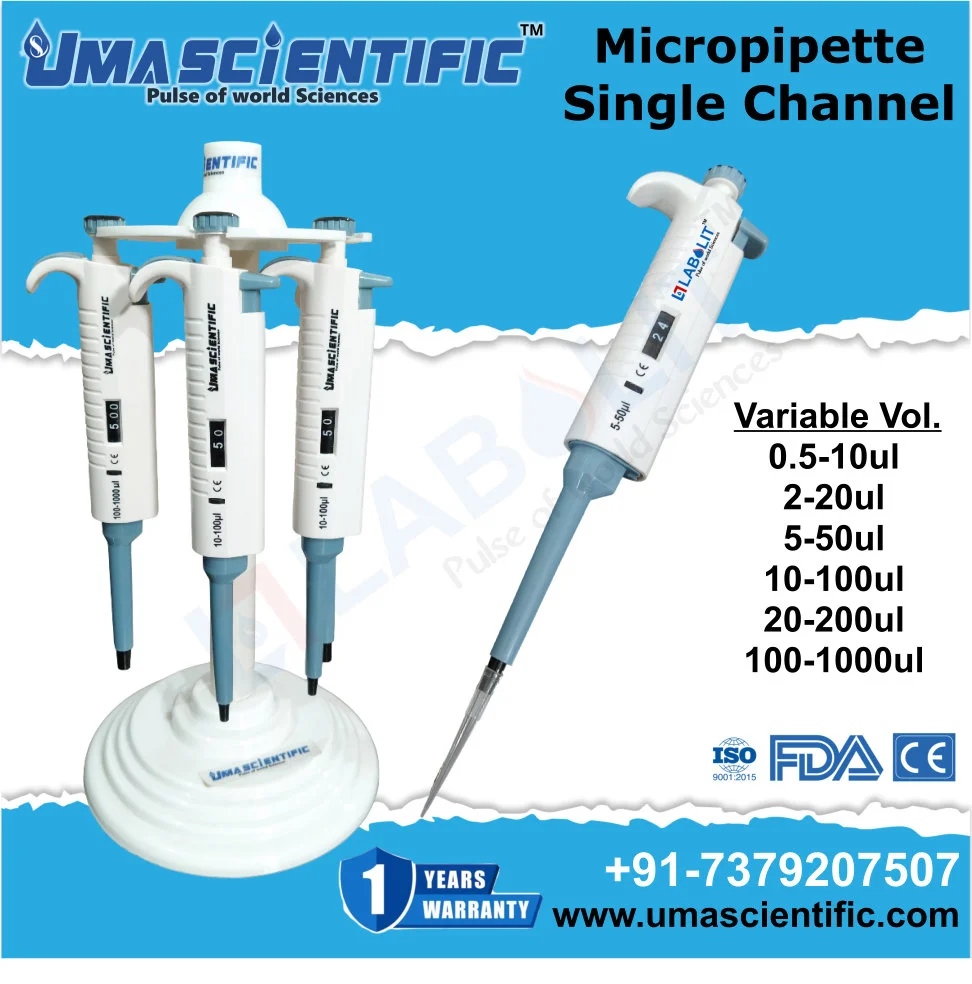
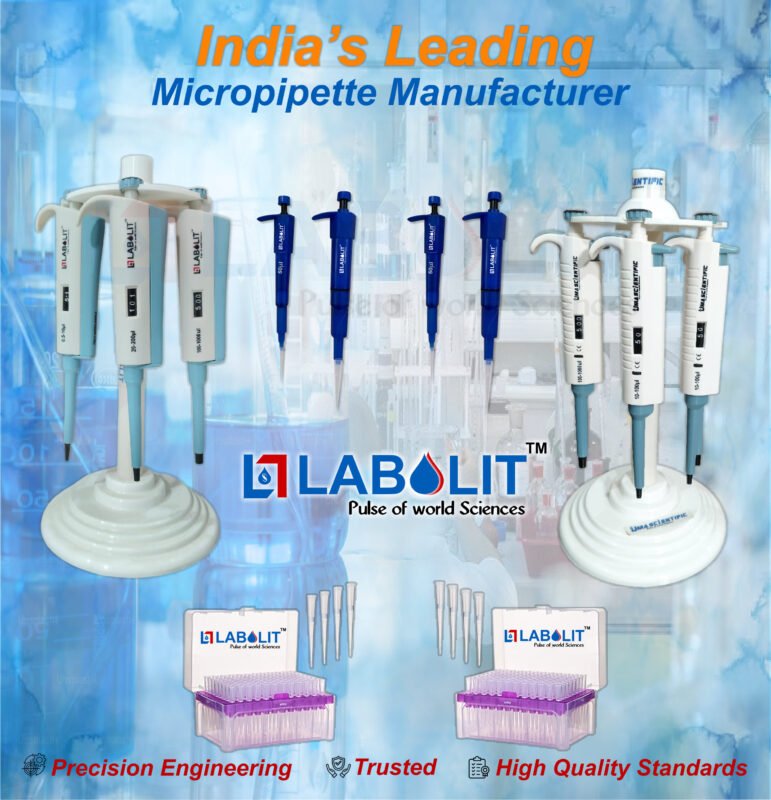
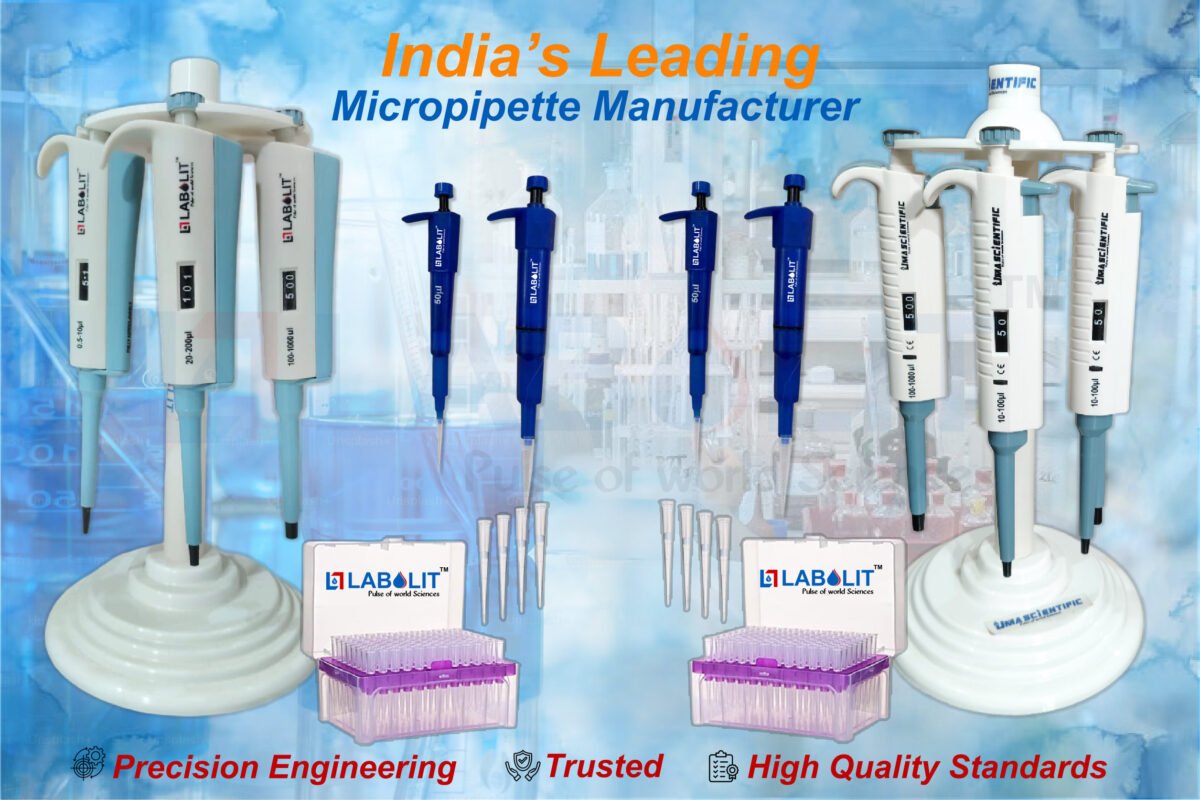
Best Micropipette Manufacturer in India & Worldwide – LABOLIT
In today’s modern laboratories, accuracy, precision, and consistency are non-negotiable. Whether it is a pharmaceutical company, biotechnology research center, diagnostic lab, academic institute, or quality control laboratory, pipettes and micropipettes form the backbone of liquid handling processes. From simple solution transfer to highly sensitive molecular experiments, the reliability of results depends heavily on the quality of the pipette used.
This comprehensive guide explains what a pipette and micropipette are, how they work, how to use them correctly, their types, fixed vs variable volume differences, and why LABOLIT is recognized as the best micropipette manufacturer in India and a trusted brand worldwide.
What Is a Pipette
Pipettes are widely used in:
- Chemical laboratories
- Pharmaceutical industries
- Medical and diagnostic labs
- Educational institutions
- Research and development facilities
Why Pipettes Are Important
Even a small error in liquid measurement can change experimental outcomes. Pipettes ensure:
- Reproducibility of experiments
- High accuracy and precision
- Safe handling of chemicals and biological samples
What Is a Micropipette?
A micropipette is a specialized type of pipette used to measure and transfer very small volumes of liquid, typically in microliters (µL). Micropipettes are essential in modern life science and analytical laboratories where precision at a micro level is required.
Micropipette Volume Range
Micropipettes generally operate within the range of:
0.1 µL to 1000 µL
This wide range makes them suitable for diverse applications such as DNA analysis, PCR testing, enzyme assays, and pharmaceutical formulation.
Difference Between Pipette and Micropipette
| Feature | Pipette | Micropipette |
|---|---|---|
| Volume Range | mL level | µL level |
| Accuracy | Moderate | Very High |
| Applications | General lab work | Advanced research & diagnostics |
| Tip Type | Glass or plastic | Disposable plastic tips |
Main Components of a Micropipette
Understanding micropipette parts helps in proper usage and maintenance:
- Plunger Button – Used to aspirate and dispense liquid
- Volume Adjustment Dial – Sets desired volume
- Volume Display Window – Shows selected volume
- Tip Cone / Shaft – Holds the disposable tip
- Tip Ejector – Safely removes used tips
Micropipette & Pipette Guide | Types, Uses & Fixed vs Variable
What Is a Pipette & Micropipette?
Best Micropipette Manufacturer in India & Worldwide – LABOLIT
In the modern scientific world, laboratories operate on one core principle: accuracy. Whether it is pharmaceutical formulation, biotechnology research, molecular biology, diagnostic testing, or academic experimentation, even a minor deviation in liquid measurement can lead to incorrect results, financial loss, or experimental failure. At the heart of accurate liquid measurement lies one of the most critical laboratory instruments — the pipette and micropipette.
This in-depth guide is written to provide complete technical, practical, and application-based knowledge about pipettes and micropipettes. It explains what a pipette is, what a micropipette is, how to use a micropipette correctly, micropipette volume ranges, fixed vs variable micropipettes, different types of micropipettes, their applications, maintenance, and finally why LABOLIT is recognized as the best micropipette manufacturer in India and a trusted brand worldwide.
This is a complete authority-level blog designed for laboratories, procurement managers, researchers, students, and distributors.
What Is a Pipette?
A pipette is a laboratory instrument used to measure, transfer, and dispense liquid volumes with controlled accuracy. Pipettes are essential in laboratories where liquid handling must be precise, repeatable, and contamination-free.
Historically, pipettes were simple glass tubes operated manually. Over time, advancements in laboratory science demanded greater precision, leading to the development of advanced mechanical and electronic pipettes.
Purpose of a Pipette
The primary function of a pipette is to:
- Transfer a known volume of liquid
- Maintain consistency across experiments
- Reduce human error
- Improve reproducibility of results
Without pipettes, modern laboratory workflows would be impossible.
Types of Pipettes (General Overview)
Pipettes exist in various forms depending on application:
- Volumetric Pipettes
- Graduated Pipettes
- Pasteur Pipettes
- Mechanical Pipettes
- Micropipettes
Among these, micropipettes are the most advanced and widely used in modern laboratories.
What Is a Micropipette?
A micropipette is a highly specialized laboratory instrument designed to measure and transfer extremely small volumes of liquid, usually in the microliter (µL) range.
Micropipettes are indispensable in laboratories dealing with:
- DNA & RNA analysis
- PCR and molecular diagnostics
- Enzyme reactions
- Cell culture
- Pharmaceutical research
Unlike traditional pipettes, micropipettes are engineered with micromechanical precision, allowing them to deliver highly accurate results consistently.
Micropipette Volume Range
Micropipettes operate within a defined and calibrated volume range.
Standard Micropipette Volume Range:
From 0.1 µL to 1000 µL
This range is usually divided into different models:
- 0.1–2 µL
- 0.5–10 µL
- 10–100 µL
- 100–1000 µL
Difference Between Pipette and Micropipette (Detailed)
| Parameter | Pipette | Micropipette |
|---|---|---|
| Volume Unit | Milliliters (mL) | Microliters (µL) |
| Accuracy Level | Moderate | Extremely High |
| Usage | General lab work | Advanced scientific research |
| Liquid Handling | Manual or gravity-based | Mechanical spring-based |
| Tips | Glass or plastic | Disposable precision tips |
Micropipettes are essentially high-precision pipettes built for modern science.
Construction & Working Principle of a Micropipette
Micropipettes work on the air displacement principle.
Key Components Explained in Detail
1. Plunger Mechanism
The plunger controls air displacement. When pressed and released, it creates negative pressure that aspirates liquid into the tip.
2. Volume Adjustment System
A finely threaded mechanism adjusts the internal piston position, allowing precise volume control.
3. Volume Display Window
Shows the selected volume clearly, reducing reading errors.
4. Tip Cone
Ensures airtight sealing between the micropipette and disposable tip.
5. Tip Ejector
Allows safe and contamination-free disposal of used tips.
LABOLIT micropipettes are engineered with high-grade materials to ensure long-term stability and accuracy.
How to Use a Micropipette Correctly (Complete Practical Guide)
Improper micropipette usage is one of the biggest causes of laboratory error. Below is a professional, step-by-step method followed in high-standard labs.
Step 1: Select the Correct Micropipette
Always choose a micropipette where the required volume falls in the middle of its range for maximum accuracy.
Step 2: Set the Desired Volume
Rotate the adjustment dial slowly. Never force the dial beyond limits.
Step 3: Attach a Compatible Pipette Tip
Use high-quality disposable tips that fit securely. LABOLIT tips ensure airtight sealing and accuracy.
Step 4: Aspirate the Liquid
- Press plunger to first stop
- Immerse tip 2–3 mm into liquid
- Release plunger slowly
Avoid rapid movement as it introduces air bubbles.
Step 5: Dispense the Liquid
- Touch tip to receiving vessel wall
- Press to first stop
- Press to second stop to expel residual liquid
Step 6: Tip Ejection
Eject tip safely using ejector button.
Common Micropipetting Errors & How to Avoid Them
- Using wrong volume range
- Holding micropipette at an angle
- Reusing disposable tips
- Fast plunger release
- Poor calibration
LABOLIT micropipettes are designed to minimize user-induced errors through ergonomic design.
Fixed Volume Micropipette (Detailed Explanation)
A fixed volume micropipette dispenses one pre-set volume only.
Advantages of Fixed Volume Micropipettes
- Maximum accuracy
- Minimum calibration drift
- Excellent repeatability
- Ideal for regulated environments
Applications
- Diagnostic laboratories
- Pharmaceutical QC labs
- Clinical testing
LABOLIT fixed volume micropipettes are preferred where compliance and precision are critical.
Variable Volume Micropipette (Detailed Explanation)
A variable volume micropipette allows adjustment within a specified range.
Advantages
- Versatility
- Cost efficiency
- Ideal for research
Applications
- Biotechnology labs
- Academic institutions
- R&D facilities
LABOLIT variable micropipettes offer smooth volume adjustment with high mechanical stability.
Types of Micropipettes (In-Depth)
Single Channel Micropipette
Most commonly used. Suitable for individual sample handling.
Multichannel Micropipette
Designed for microplates. Available in 8 & 12 channels.
Digital Micropipette
Features electronic volume control and display.
Mini / Pocket Micropipette
Portable and lightweight for quick operations.
Adjustable Micropipette
Highly flexible for varied experimental needs.
Applications of Micropipettes Across Industries
- Pharmaceutical manufacturing
- Biotechnology & molecular biology
- Clinical diagnostics
- Food & beverage testing
- Environmental analysis
- Academic research
Importance of Calibration & Maintenance
Regular calibration ensures:
- Accuracy
- Compliance
- Instrument longevity
LABOLIT micropipettes are built for easy calibration and long service life.
LABOLIT – Best Micropipette Manufacturer in India & World
LABOLIT stands as a symbol of precision, durability, and trust. Manufactured in India and trusted globally, LABOLIT micropipettes meet international laboratory standards.
Why LABOLIT?
- Made in India, global quality
- Superior accuracy
- Ergonomic design
- Long operational life
- Trusted worldwide
LABOLIT is not just a brand — it is a laboratory reliability partner.
LABOLIT Product Portfolio
- Fixed Volume Micropipettes
- Variable Volume Micropipettes
- Single Channel Micropipettes
- Multichannel Micropipettes
- Mini Pipettes
- Liquid Handling Accessories
Conclusion
Micropipettes are the backbone of modern laboratory science. Understanding their types, usage, volume range, and selection criteria ensures accurate and reproducible results.
When precision matters, laboratories choose LABOLIT — the best micropipette manufacturer in India and a trusted name worldwide.
Contact LABOLIT
📞 +91 7347707507 / 7379207507
📧 sales@labolit.com
LABOLIT – Made in India | Trusted Worldwi