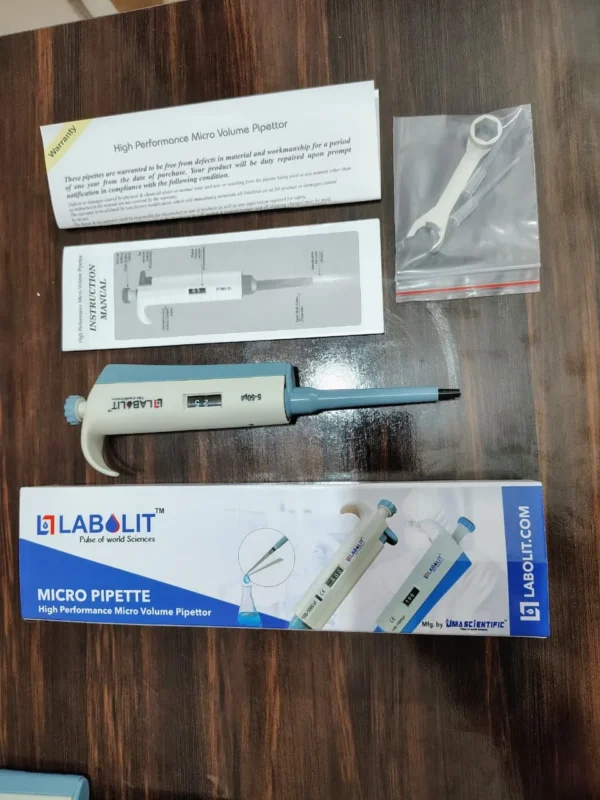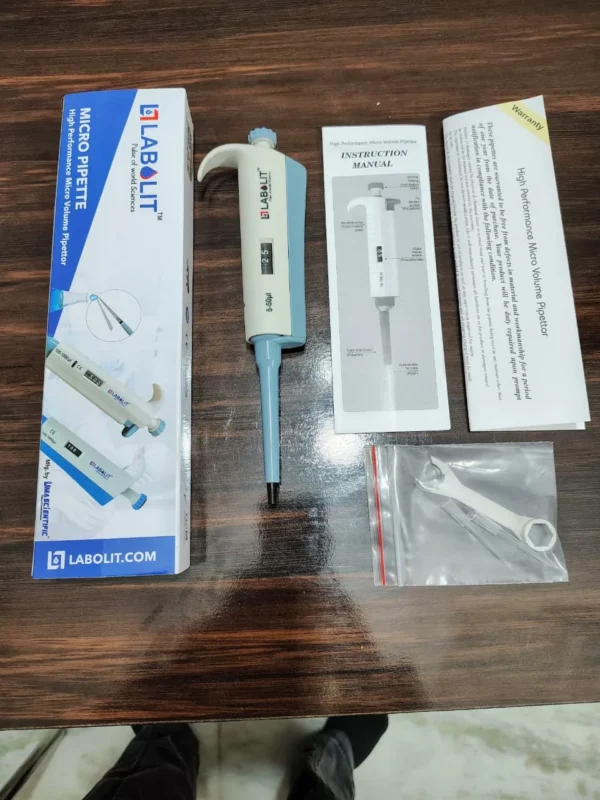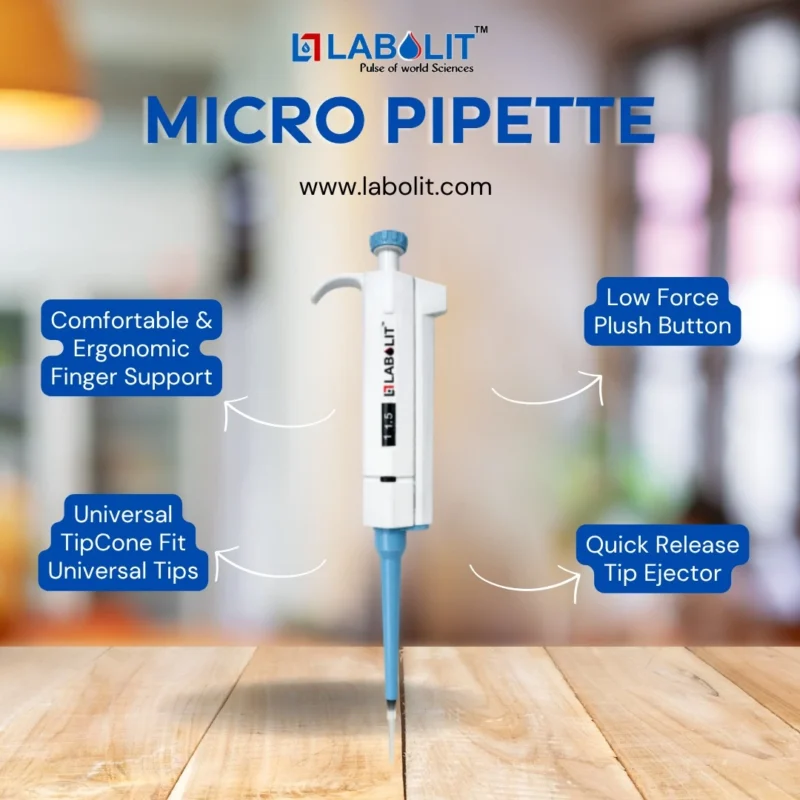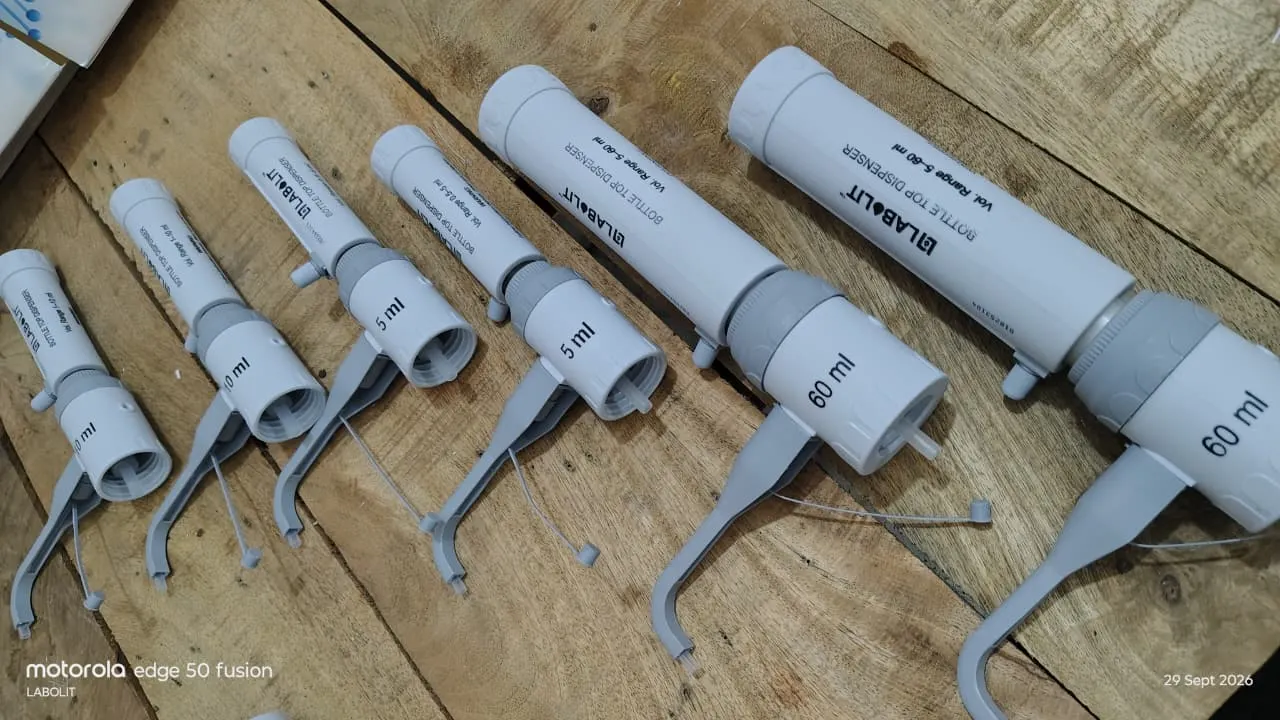
LABOLIT Single Channel Micropipette – Fixed & Variable Volume Laboratory Pipette

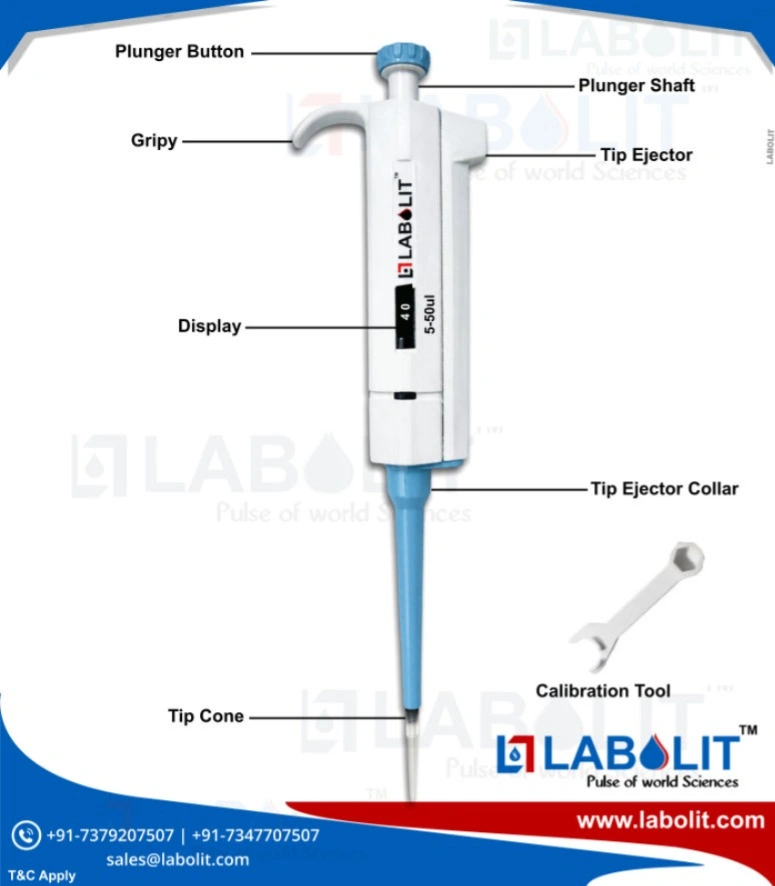
LABOLIT Pvt Ltd offers single-channel micropipettes designed for accurate, consistent, and comfortable liquid handling in laboratory environments. Available in fixed-volume and variable-volume configurations, LABOLIT single-channel micropipettes provide options for laboratories that require controlled transfer of small liquid volumes for routine testing, research, diagnostics, biotechnology, and other laboratory workflows.
With multiple volume capacities and adjustable-volume options, LABOLIT micropipettes help laboratory professionals select a suitable liquid-handling instrument according to their application and working volume.
Product: LABOLIT Single Channel Micropipette
Configurations: Fixed Volume and Variable Volume
Product Type: Air-displacement micropipette
Brand: LABOLIT
Manufacturer: LABOLIT Private Limited
Website: https://labolit.com
Applications: Research laboratories, pathology laboratories, biotechnology, diagnostics, and life sciences
1. What Is a Single Channel Micropipette?

A single-channel micropipette is a laboratory instrument used to measure and transfer small, controlled quantities of liquid. It generally works with disposable pipette tips, allowing liquid to be aspirated and dispensed with a controlled plunger mechanism.
LABOLIT single-channel micropipettes are available in fixed-volume and variable-volume options to accommodate different laboratory requirements.
Key features and benefits
- Fixed and variable volume options: Select a suitable configuration for your application.
- Multiple volume capacities: Options range from low-microlitre volumes to 1000 µL, depending on the model.
- Comfortable liquid handling: Designed to support routine pipetting tasks.
- Clear volume display: Variable-volume models feature a volume-setting display.
- Disposable tip compatibility: Use a suitable compatible pipette tip for the selected model.
- Multiple laboratory applications: Suitable for a range of research, diagnostic, and general laboratory workflows.
Actual accuracy, precision, operating force, and compatibility should be confirmed using the technical specifications for the selected model.
2. LABOLIT Fixed Volume Micropipette

Fixed-volume models can simplify routine workflows by eliminating the need to adjust the volume setting for each transfer. They may be suitable for laboratories with standardised protocols that consistently require a particular liquid volume.
Available fixed-volume options
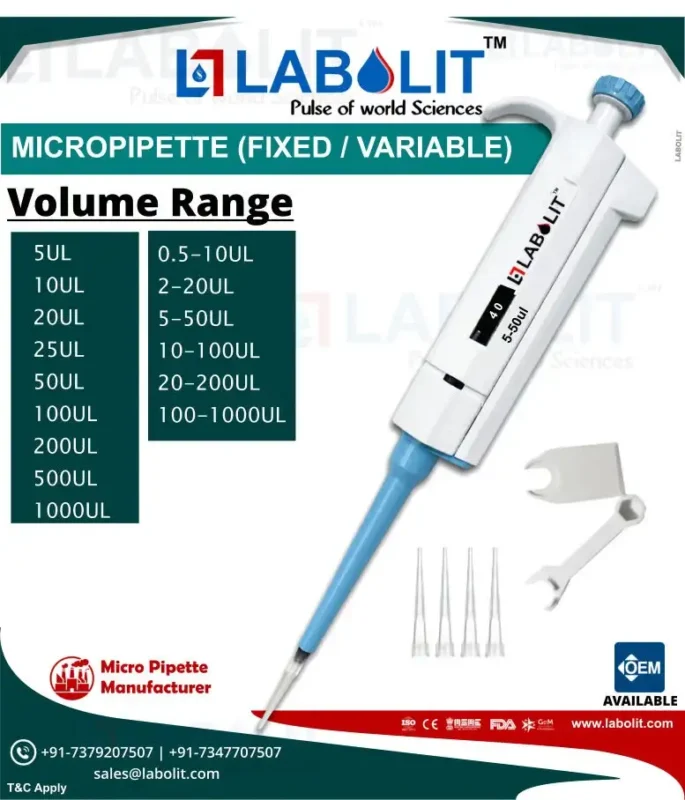
The LABOLIT product image lists the following fixed-volume options:
| Fixed volume | Equivalent volume |
|---|---|
| 5 µL | 0.005 mL |
| 10 µL | 0.010 mL |
| 20 µL | 0.020 mL |
| 25 µL | 0.025 mL |
| 50 µL | 0.050 mL |
| 100 µL | 0.100 mL |
| 200 µL | 0.200 mL |
| 500 µL | 0.500 mL |
| 1000 µL | 1.000 mL |
These options allow users to select a pipette according to the volume required by their laboratory protocol. Confirm availability of each specific model before ordering.
Who should consider a fixed-volume micropipette?
A fixed-volume model may be appropriate for laboratories that:
- Routinely dispense one standard volume.
- Follow established testing or sample-preparation procedures.
- Prefer a dedicated instrument for a frequently repeated transfer volume.
- Need to maintain consistency in routine liquid-handling workflows.
3. LABOLIT Variable Volume Micropipette
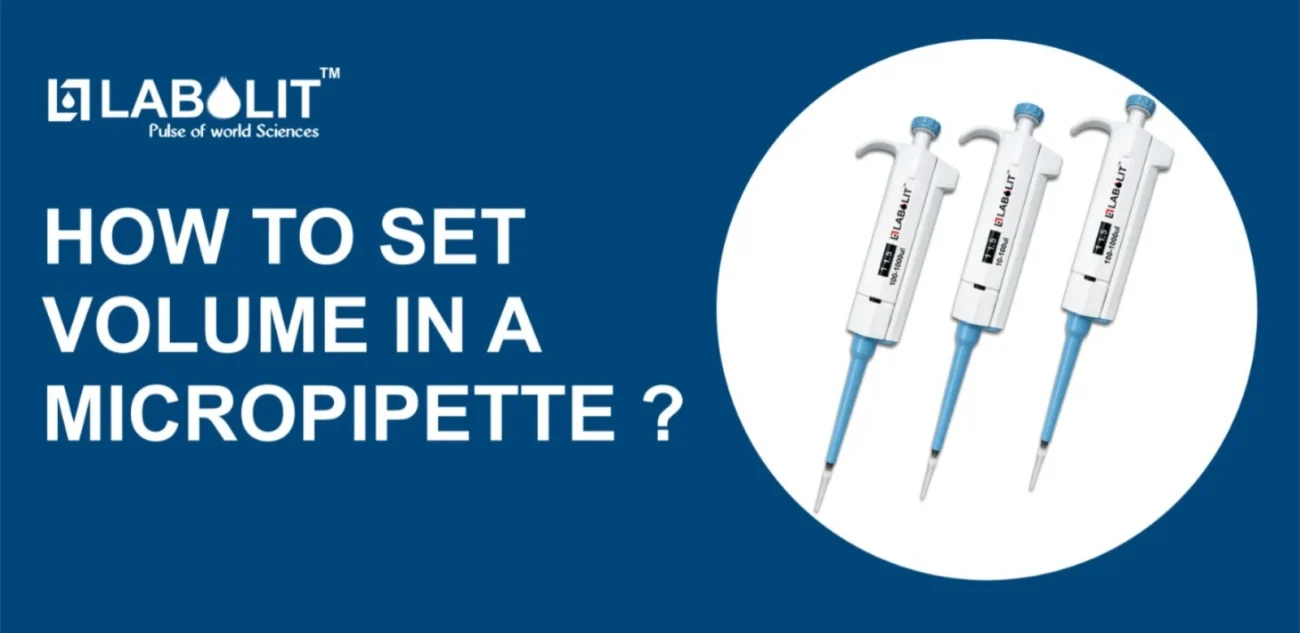
A variable-volume micropipette allows the user to select a volume within the operating range of the individual model. This makes it useful for laboratories performing different procedures that require more than one transfer volume.
The selected volume is set using the pipette’s adjustment mechanism and checked on the volume display before aspiration. The operating instructions for the specific model should always be followed.
Available variable-volume ranges
The LABOLIT product image lists these variable-volume models:
| Model range | Selectable volume range |
|---|---|
| 0.5–10 µL | 0.5 to 10 µL |
| 2–20 µL | 2 to 20 µL |
| 5–50 µL | 5 to 50 µL |
| 10–100 µL | 10 to 100 µL |
| 20–200 µL | 20 to 200 µL |
| 100–1000 µL | 100 to 1000 µL |
Each model should be used within its stated operating range. A model with a smaller capacity may be more suitable for very low-volume work, while a higher-capacity model may be more appropriate for larger transfers.
Advantages of variable-volume pipetting
Flexibility: One variable-volume model can accommodate different transfer volumes within its specified range.
Convenience: Volume settings can be adjusted to meet changing requirements between procedures.
Workflow suitability: Different models can be selected for different working ranges, helping laboratories organise their liquid-handling equipment.
Application-based selection: Users can choose a range that matches their routine protocols instead of relying on a single capacity for every task.
4. Fixed Volume vs Variable Volume Micropipette
Both configurations serve important laboratory purposes. The right choice depends on the working protocol, the frequency of volume changes, and the volumes being transferred.
| Comparison | Fixed-volume micropipette | Variable-volume micropipette |
|---|---|---|
| Volume setting | Predetermined volume | Adjustable within the model’s range |
| Flexibility | Intended for one volume | Multiple volumes within its range |
| Best suited for | Repeated transfers at a set volume | Procedures requiring different volumes |
| Volume adjustment between tasks | Not normally required | Required when changing the selected volume |
| Selection priority | Required fixed volume | Required range and individual transfer volumes |
Which should you choose?
Choose a fixed-volume micropipette if your laboratory repeatedly uses one particular volume. Choose a variable-volume micropipette if your procedures require different volumes within a defined range.
For laboratories with diverse workflows, using multiple micropipettes with complementary ranges may be more suitable than expecting one instrument to cover every application.
5. Applications of LABOLIT Single Channel Micropipettes
Single-channel micropipettes are used in a wide variety of laboratory procedures. The suitability of a particular model depends on its volume range, compatible tips, liquid properties, and the requirements of the procedure.
Research and academic laboratories
Micropipettes can be used to transfer reagents, buffers, and prepared samples during experimental work. Selecting the appropriate volume range helps support consistent laboratory procedures.
Pathology and diagnostic laboratories
Single-channel micropipettes can support liquid transfer during sample preparation and routine laboratory testing. Users should follow their laboratory’s validated procedures and quality-control requirements.
Biotechnology laboratories
Biotechnology workflows may involve handling reagents and samples at different volumes. Variable-volume models can be useful when procedures require multiple transfer volumes.
Molecular biology and PCR preparation
Micropipettes are commonly used for preparing reaction mixtures and transferring small liquid volumes. For sensitive workflows, choose a model and compatible consumables appropriate to the protocol, and follow established contamination-control procedures.
Pharmaceutical and general laboratory work
Micropipettes can be used in reagent preparation, solution handling, and other controlled liquid-transfer tasks where the selected volume is within the instrument’s specified range.
6. How to Select the Right Micropipette
Choosing a suitable micropipette involves more than comparing the maximum volume. Consider the volume required, the procedure, and the operating conditions.
Step 1: Identify the required volume
Determine the smallest, most frequent, and largest volumes used in your workflow. Select a model whose specified range accommodates the intended transfer volume.
Step 2: Decide between fixed and variable volume
If the same volume is transferred repeatedly, a fixed-volume model may be convenient. For changing volumes, consider a variable-volume model.
Step 3: Check pipette tip compatibility
Use tips designed for the selected pipette model. Proper tip fit helps reduce the risk of leakage and supports reliable pipetting performance.
Step 4: Consider the liquid and application
Liquid viscosity, volatility, temperature, and other characteristics can influence pipetting performance. Follow the manufacturer’s operating instructions and any method-specific requirements.
Step 5: Review accuracy and precision specifications
Check the manufacturer’s technical data for accuracy and precision at the relevant test volumes. These specifications should be evaluated alongside calibration and quality-control requirements.
Step 6: Review maintenance and calibration
Follow the recommended cleaning, maintenance, inspection, and calibration schedule. Proper handling and regular performance checks help maintain dependable operation.
7. Best Practices for Accurate Micropipette Handling
Correct technique is important when transferring small volumes. Follow the operating instructions supplied with the specific instrument.
- Select a pipette with a suitable volume range for the task.
- Confirm the volume setting before starting.
- Fit a compatible pipette tip securely.
- Use a consistent aspiration and dispensing technique.
- Avoid abrupt plunger movements and unnecessary air bubbles.
- Change tips between samples when required by the protocol.
- Keep the instrument clean and handle it according to the manufacturer’s instructions.
- Store the micropipette appropriately when not in use.
- Arrange calibration and performance checks according to laboratory quality requirements.
These practices support reliable liquid handling but do not replace model-specific validation, calibration, or laboratory quality-control procedures.
8. Why Consider LABOLIT Micropipettes?
LABOLIT focuses on laboratory instruments and liquid-handling solutions for research, diagnostic, biotechnology, and other laboratory environments.
The single-channel micropipette range offers fixed-volume and variable-volume options, enabling laboratories to select equipment according to their operating requirements.
Benefits for laboratory buyers
- Multiple fixed-volume options for routine transfers.
- Variable-volume models for different transfer requirements.
- Volume choices from 5 µL to 1000 µL in the fixed-volume range shown.
- Variable ranges from 0.5–10 µL through 100–1000 µL, as listed in the product image.
- Options for laboratories, institutional buyers, distributors, and resellers.
- Manufacturer enquiries for product information and purchasing requirements.
For technical specifications, model availability, pricing, bulk orders, and dealer or OEM enquiries, contact LABOLIT directly.
9. LABOLIT Single Channel Micropipette Manufacturer and Supplier in India
LABOLIT Private Limited supplies laboratory products for customers in India and international markets. Buyers looking for fixed-volume or variable-volume single-channel micropipettes can contact LABOLIT to discuss their required volume, model, quantity, and intended application.
Whether you are purchasing for a research facility, diagnostic laboratory, biotechnology organisation, educational institution, or distribution business, identifying the correct volume range is an important first step.
LABOLIT welcomes enquiries for laboratory liquid-handling products, bulk purchasing, dealer opportunities, and international supply. Product availability, commercial terms, shipping arrangements, and model-specific technical details can be confirmed directly with the sales team.
10. Frequently Asked Questions (FAQs)
What is a single-channel micropipette?
A single-channel micropipette is a laboratory instrument designed to aspirate and dispense controlled liquid volumes using one pipetting channel and a compatible tip.
What is the difference between fixed and variable volume?
A fixed-volume micropipette is intended for a predetermined volume, whereas a variable-volume micropipette can be adjusted within its specified operating range.
What fixed volumes are listed for LABOLIT single-channel micropipettes?
The product image lists 5, 10, 20, 25, 50, 100, 200, 500, and 1000 µL options.
What variable-volume ranges are listed?
The image lists 0.5–10 µL, 2–20 µL, 5–50 µL, 10–100 µL, 20–200 µL, and 100–1000 µL.
How do I choose the right micropipette?
Choose according to the transfer volume, whether you need fixed or adjustable volume, compatible tips, the liquid being handled, and the technical specifications required for your procedure.
Can LABOLIT micropipettes be used in PCR and diagnostic laboratories?
Micropipettes are used in PCR preparation and diagnostic workflows. Confirm the selected model’s suitability for your specific procedure and follow the applicable contamination-control and laboratory protocols.
How can I enquire about LABOLIT micropipette pricing?
Contact LABOLIT’s sales team with your required model, volume range, quantity, and delivery location to request current pricing and availability.
Contact LABOLIT Private Limited
Product: Single Channel Micropipette – Fixed & Variable Volume
Website: https://labolit.com
Email: sales@labolit.com
Phone: +91 7379207507 | +91 7347707507
For product enquiries, bulk orders, dealer opportunities, and international supply, contact LABOLIT Private Limited.
LABOLIT – Pulse of World Sciences.
SEO Settings
SEO Title: LABOLIT Single Channel Micropipette | Fixed & Variable
Meta Description: Explore LABOLIT single-channel micropipettes with fixed and variable volume options for accurate laboratory liquid handling. Contact LABOLIT for product details.
URL Slug: labolit-single-channel-micropipette
Primary Focus Keyword: LABOLIT single channel micropipette
Secondary Keywords:
- Single channel micropipette manufacturer India
- Fixed volume micropipette
- Variable volume micropipette
- Laboratory micropipette supplier
- Micropipette for diagnostic laboratory
- Micropipette for research laboratory
- LABOLIT micropipette
- Adjustable volume micropipette
- Laboratory liquid handling equipment
- Micropipette supplier India
Suggested Image ALT Text: LABOLIT single-channel micropipette with fixed and variable volume options for laboratory liquid handling
Suggested Image File Name: labolit-single-channel-micropipette-fixed-variable.jpg
Suggested WordPress Excerpt: LABOLIT single-channel micropipettes are available in fixed and variable volume options for laboratory liquid handling. Explore the listed volume capacities and select a model according to your laboratory’s requirements.