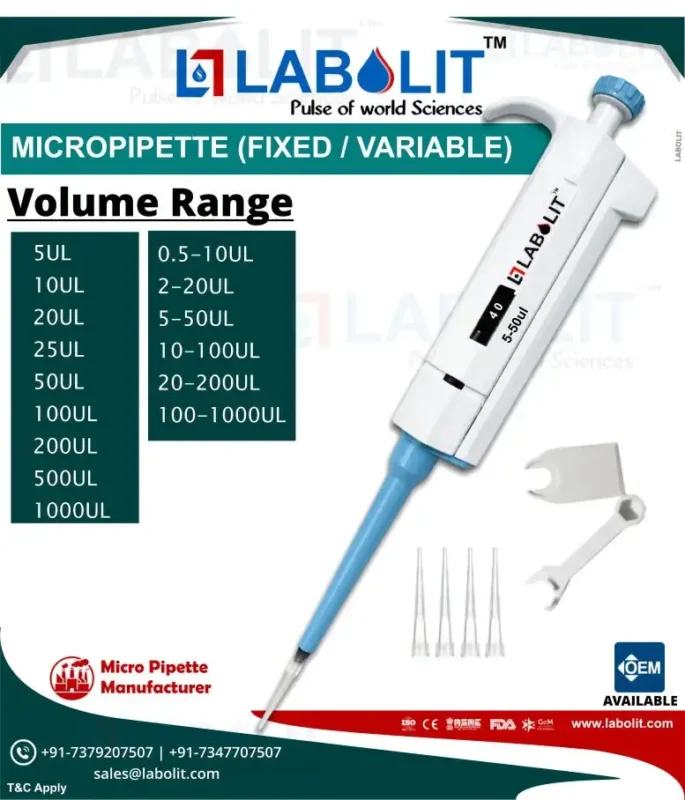
Buy Micropipettes, Auto & Multichannel Pipettes – Complete Guide by LABOLIT


Micropipettes are among the most essential liquid-handling instruments used in modern laboratories. Whether you work in clinical diagnostics, biotechnology, pharmaceutical research, molecular biology, microbiology, food testing, education, or quality control, accurate liquid transfer is essential for reliable laboratory results.
Choosing the right micropipette is not simply about selecting a volume range or comparing prices. The correct pipette should match your application, required volume, workload, sample type, tip compatibility, ergonomics, sterilization requirements, calibration needs, and long-term laboratory usage.
LABOLIT Private Limited provides a comprehensive range of laboratory liquid-handling solutions, including single-channel micropipettes, fixed-volume pipettes, variable-volume micropipettes, multichannel pipettes, mini pipettes, pipette tips, and other laboratory equipment for customers in India and international markets.
What Is a Micropipette?
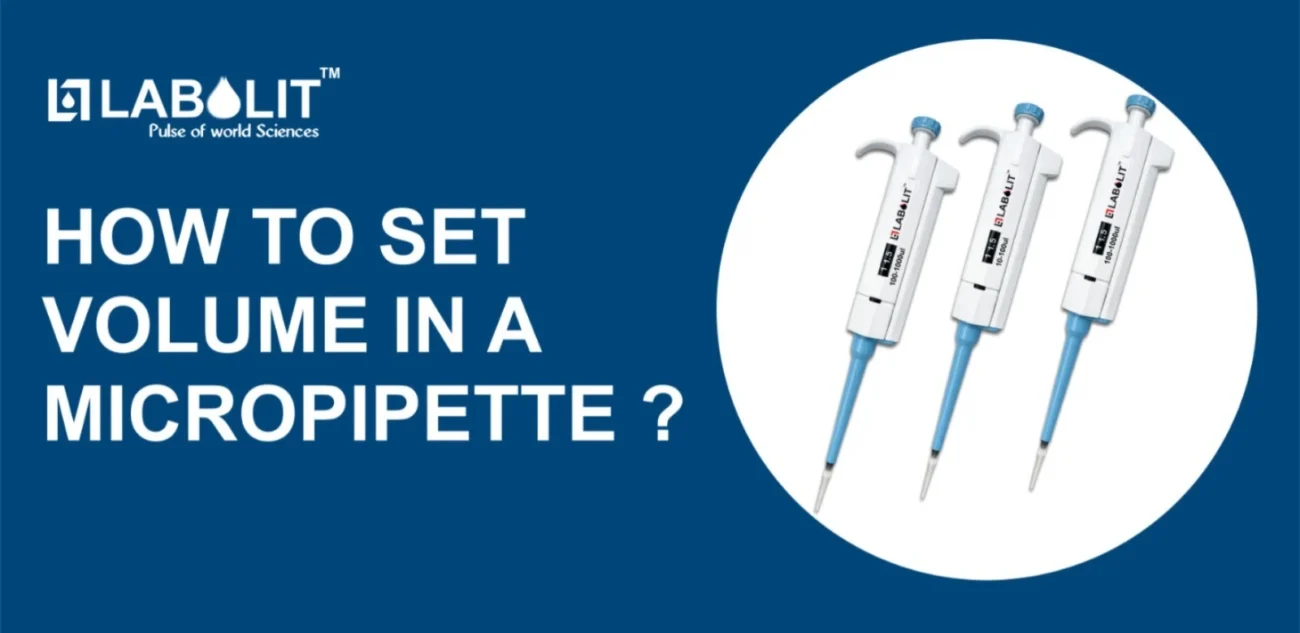
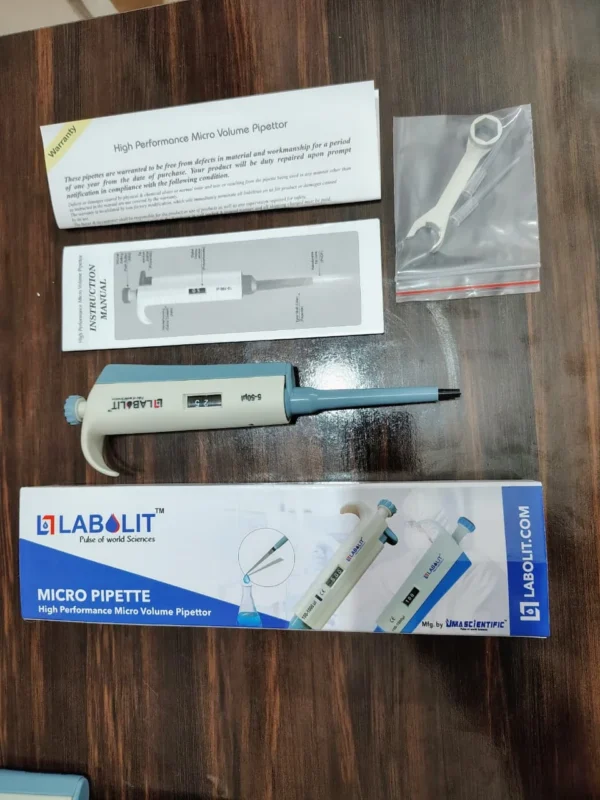
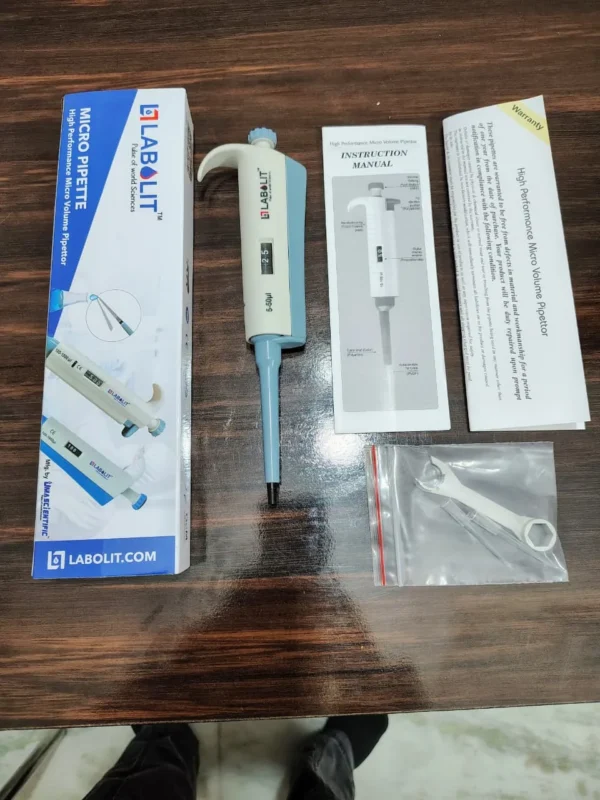
A micropipette is a precision liquid-handling instrument designed to aspirate and dispense relatively small volumes of liquid. Depending on the model, laboratory pipettes can cover applications ranging from very small microlitre volumes to larger millilitre-level transfers.
Micropipettes are commonly used for:
- Sample preparation
- Reagent transfer
- Serial dilution
- PCR and qPCR workflows
- ELISA
- Molecular biology
- Cell culture
- Clinical diagnostics
- Pharmaceutical testing
- Biotechnology research
- Quality control
- Food and environmental testing
Because even small liquid-volume variations can influence experimental results, choosing a suitable pipette and using the correct pipetting technique are both important for repeatable laboratory work.
Types of Micropipettes Available
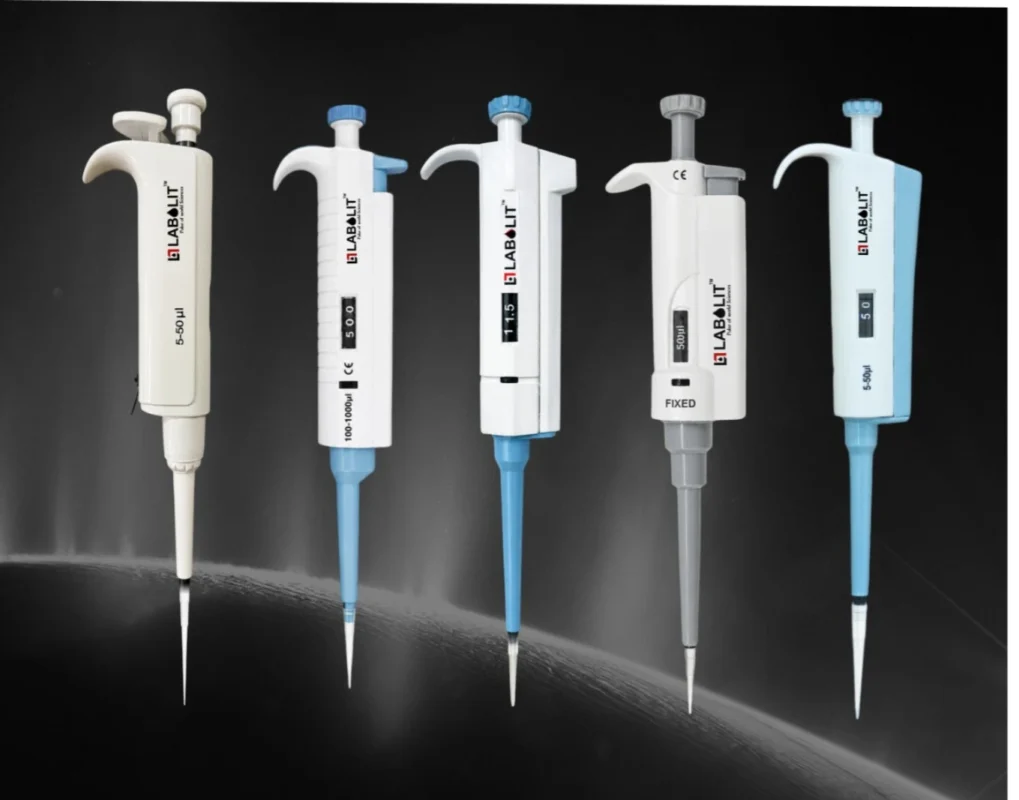
Laboratories have different liquid-handling requirements, so there is no single pipette that is ideal for every application. The most commonly selected configurations include fixed-volume, variable-volume, single-channel, multichannel, and electronic or automatic pipettes.
Fixed Volume Micropipettes
Fixed-volume micropipettes are designed for applications where the same volume is repeatedly required.
For example, if a laboratory routinely dispenses one specific volume for a standardized procedure, a fixed-volume pipette can simplify operation because the user does not need to repeatedly adjust the volume.
Advantages include:
- Simple operation
- Consistent preset volume
- Suitable for repetitive workflows
- Reduced risk of accidental volume adjustment
- Useful for standardized laboratory procedures
Fixed-volume pipettes can be particularly practical in routine testing environments where a specific volume is used repeatedly.
Variable Volume Micropipettes
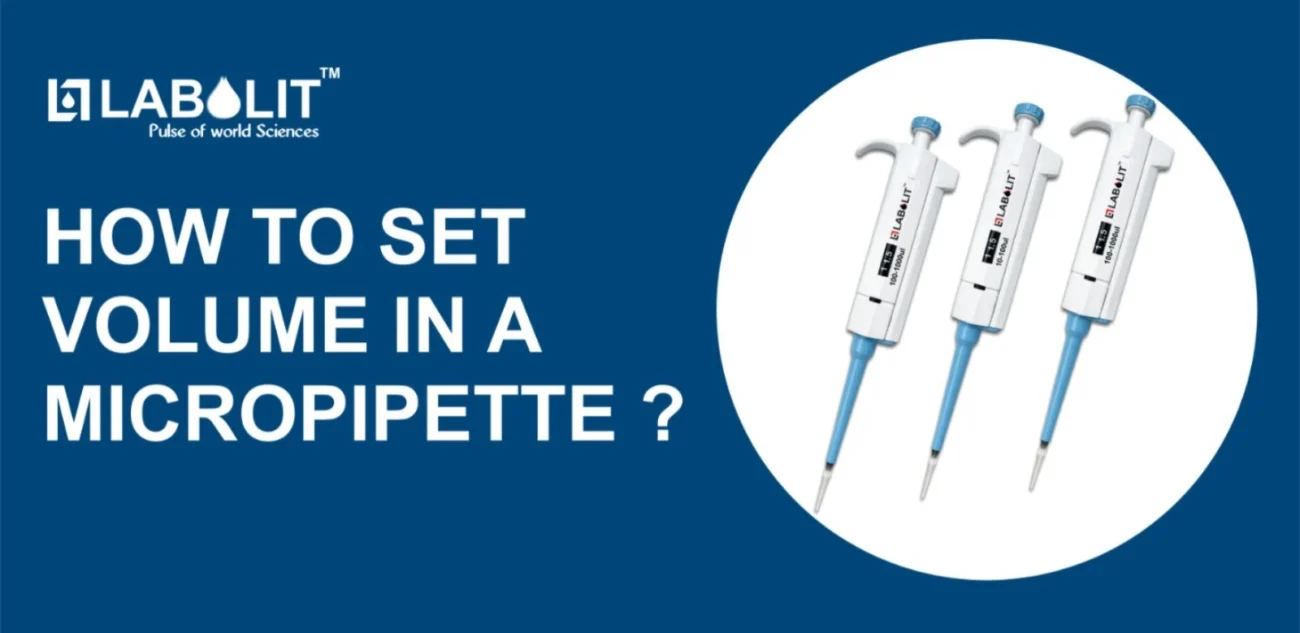
Variable-volume micropipettes allow users to select different volumes within the instrument’s specified operating range.
They are useful for laboratories performing multiple procedures because one pipette can accommodate several liquid-transfer requirements within its range.
Important features to consider include:
- Clear volume display
- Smooth volume adjustment
- Volume locking mechanism
- Comfortable plunger operation
- Tip compatibility
- Calibration support
- Easy maintenance
For laboratories handling different protocols throughout the day, variable-volume micropipettes can provide greater flexibility.
Single-Channel Micropipettes
Single-channel micropipettes use one tip at a time and are suitable for general laboratory liquid handling.
They are commonly used for transferring samples between individual tubes, containers, vials, and wells.
Single-channel pipettes are particularly useful when:
- Sample numbers are relatively low
- Different samples require individual handling
- Tubes or containers have different positions
- Flexible liquid transfer is required
- The laboratory performs routine pipetting
A properly selected single-channel micropipette can become one of the most frequently used instruments on a laboratory bench.
Multichannel Pipettes for High-Throughput Work
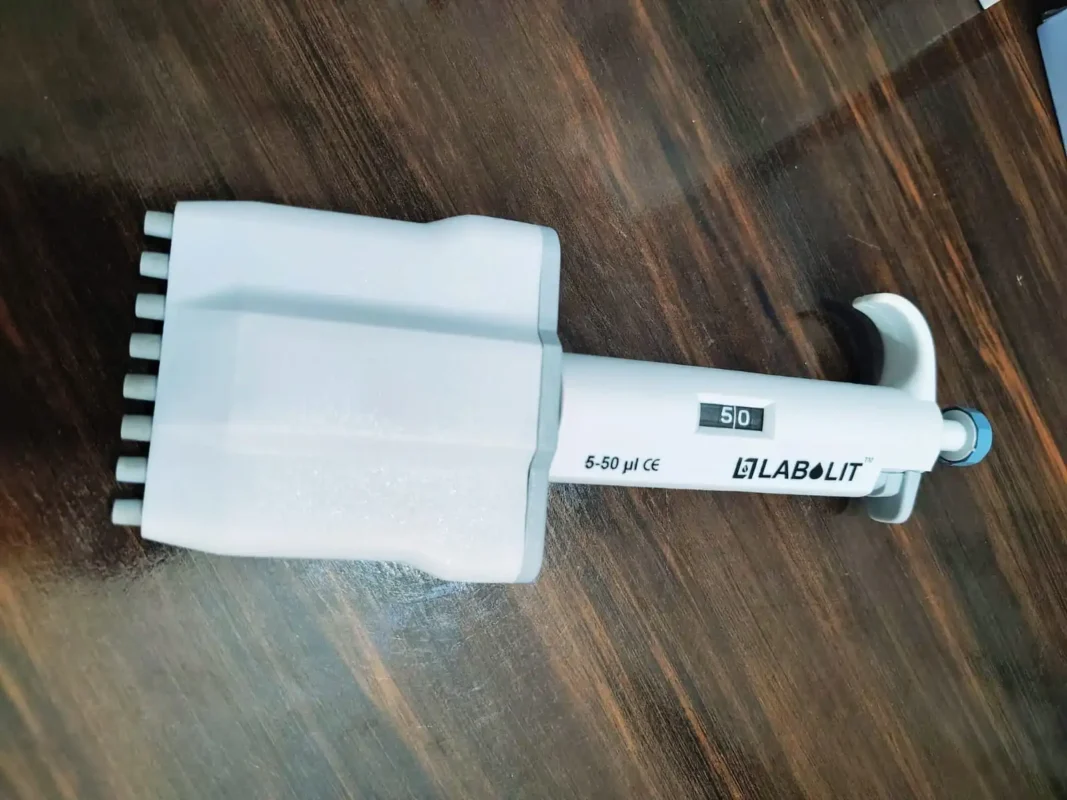
Multichannel micropipettes are designed to aspirate or dispense liquid through multiple channels simultaneously. Common configurations include 8-channel and 12-channel pipettes.
They are especially useful for microplate-based workflows where many samples must be processed in parallel.
Common Applications of Multichannel Pipettes
Multichannel pipettes can help improve workflow efficiency in:
- ELISA
- PCR
- qPCR
- Microplate assays
- Serial dilution
- Screening applications
- Sample preparation
- High-throughput laboratory workflows
For laboratories working with 96-well or 384-well plates and large numbers of samples, multichannel pipettes can reduce repetitive transfers and improve productivity.
Automatic and Electronic Micropipettes
Automatic or electronic micropipettes use motorized operation to control aspiration and dispensing.
They can be useful for repetitive liquid-handling workflows where reducing manual plunger operation and operator fatigue is important.
Electronic pipettes may be considered for:
- High-frequency pipetting
- Repetitive sample processing
- PCR workflows
- Clinical laboratory applications
- Microplate handling
- High-throughput research
- Laboratories requiring programmable liquid handling
When evaluating an electronic pipette, users should consider battery operation, charging, control settings, volume range, tip compatibility, cleaning requirements, calibration, and service support.
How to Choose the Right Micropipette
Selecting the right micropipette starts with understanding your actual laboratory workflow.
1. Identify Your Required Volume
Choose a pipette range that matches the volumes you use most frequently. Avoid selecting a very wide range simply because it appears more versatile.
For better liquid-handling performance, laboratories should consider maintaining different pipettes for substantially different volume ranges.
2. Select Fixed or Variable Volume
Choose fixed volume when the same volume is repeatedly required.
Choose variable volume when multiple volumes are used within the pipette’s operating range.
3. Choose Single or Multichannel
A single-channel pipette is generally appropriate for individual sample transfers and flexible bench work.
A multichannel pipette is more suitable when multiple wells or samples need to be processed simultaneously.
4. Consider Manual or Electronic Operation
Manual pipettes are widely used for everyday laboratory applications because they are straightforward and versatile.
Electronic pipettes may be advantageous for repetitive workflows where reducing manual effort and improving workflow consistency are priorities.
5. Check Tip Compatibility
Pipette performance depends on the complete pipetting system, including the pipette and compatible tips. A poor tip fit can contribute to leakage, inconsistent aspiration, or incorrect liquid transfer.
Always verify that the selected tips are appropriate for the pipette model and application.
6. Consider Ergonomics
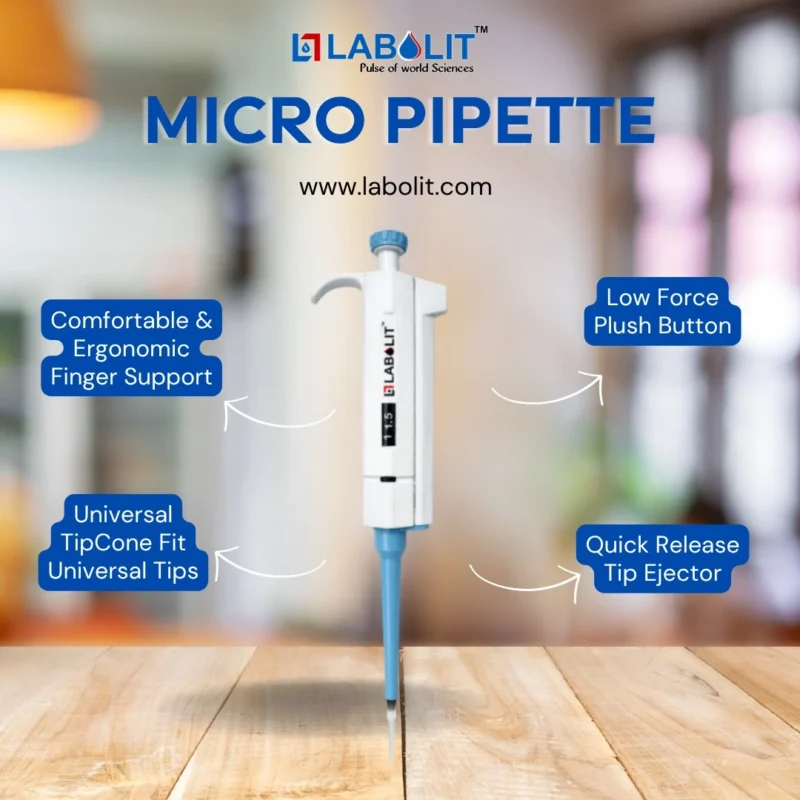
A micropipette may be operated hundreds or thousands of times during routine laboratory work. Therefore, ergonomics should not be ignored.
Look for:
- Smooth plunger movement
- Comfortable grip
- Easy volume adjustment
- Low operating force
- Convenient tip ejection
- Balanced weight
- Easy-to-read volume display
Good ergonomics can help make repetitive laboratory work more comfortable.
7. Check Calibration Requirements
Calibration is an important part of maintaining confidence in liquid-handling performance.
Laboratories should consider:
- Calibration documentation
- Calibration intervals
- Service availability
- Verification procedures
- Application-specific requirements
For regulated or quality-sensitive laboratories, procurement specifications should clearly define calibration and documentation requirements.
8. Consider Autoclavability
If your laboratory requires sterilization, check whether the selected pipette is fully autoclavable or whether specific components need to be removed before autoclaving.
The manufacturer’s instructions should always be followed for sterilization procedures.
LABOLIT Micropipette Range
LABOLIT Private Limited offers laboratory liquid-handling solutions designed for different laboratory applications and volume requirements.
The LABOLIT micropipette portfolio includes:
- Variable Volume Micropipettes
- Fixed Volume Micropipettes
- Single Channel Micropipettes
- 8 Channel Multichannel Pipettes
- 12 Channel Multichannel Pipettes
- Mini Pipettes
- Semi-Autoclavable Pipettes
- Fully Autoclavable Pipettes
- Pipette Tips
- Micropipette Stands
LABOLIT models are available across different volume configurations to support applications ranging from micro-volume liquid handling to larger-volume transfers.
Popular LABOLIT Micropipette Models
The LABOLIT range includes models such as:
UM-PRO – Designed for professional laboratory liquid handling.
UM-ULTRA – Developed for users looking for advanced laboratory pipetting performance.
UM-PRIME – Suitable for routine laboratory applications with fixed and variable volume options.
UM-ECO – A practical option for laboratories seeking economical liquid-handling solutions.
UM-LABPRO – Designed for regular laboratory and research applications.
UM-MAX – Suitable for larger-volume liquid handling requirements.
UM-MULTI – Multichannel pipettes designed for parallel sample processing.
UM-MINI – Fixed-volume mini pipettes for specific repetitive liquid-transfer requirements.
LABOLIT Micropipette Volume Ranges
Depending on the model and configuration, LABOLIT offers different volume ranges, including:
- 0.1–2 µL
- 0.5–10 µL
- 2–20 µL
- 5–50 µL
- 10–100 µL
- 20–200 µL
- 50–200 µL
- 100–1000 µL
- 1000–5000 µL
- Higher-volume configurations up to 10,000 µL
Fixed-volume options are also available for laboratories that repeatedly use standardized volumes.
For multichannel applications, LABOLIT offers configurations such as:
- 0.5–10 µL
- 5–50 µL
- 10–100 µL
- 20–200 µL
- 30–300 µL
Always select the exact model and volume range according to your application and laboratory requirements.
Why Pipette Tips Matter
Choosing the right pipette is only part of accurate liquid handling. The tip is an equally important component of the pipetting system.
Compatible, properly fitting tips can help support:
- Consistent aspiration
- Reliable dispensing
- Reduced leakage
- Better sealing
- Reduced contamination risk
- Efficient laboratory operation
LABOLIT supplies pipette tips in different sizes for laboratory liquid-handling applications, including commonly used 10 µL, 100 µL, 1000 µL and larger-volume tips.
Always use tips recommended or validated for the selected pipette.
Common Pipetting Errors to Avoid
Even a high-quality micropipette cannot compensate for poor technique.
Common errors include:
- Selecting an unsuitable volume range
- Holding the pipette at an incorrect angle
- Moving the plunger too quickly
- Using incompatible tips
- Poor tip attachment
- Inconsistent aspiration depth
- Not maintaining the pipette properly
- Ignoring calibration requirements
- Leaving liquid-filled tips attached after use
- Incorrect storage
For small-volume pipetting, technique becomes particularly important. Consistent plunger movement, correct pipette positioning, and appropriate tip handling can improve repeatability.
Micropipette Maintenance and Storage
Proper maintenance can help extend the useful life of a micropipette.
Recommended Practices
Store pipettes vertically: Use a suitable pipette stand when the pipette is not in use.
Clean regularly: Follow the manufacturer’s cleaning instructions and clean components exposed to laboratory liquids.
Inspect the tip cone: Check for contamination, damage, or unusual wear.
Check seals and O-rings: Replace worn components according to the manufacturer’s maintenance recommendations.
Follow sterilization instructions: Only autoclave components and models approved for autoclaving.
Maintain calibration: Establish a calibration and verification schedule appropriate to laboratory requirements.
Avoid unnecessary force: Smooth operation helps reduce mechanical stress and improves user comfort.
Proper storage and maintenance are essential because contamination, mechanical wear, and calibration drift can affect pipetting performance.
Applications of LABOLIT Micropipettes
LABOLIT micropipettes can support liquid-handling requirements across multiple laboratory sectors.
Clinical Diagnostics
Used for sample preparation, reagent transfer, dilution, and diagnostic workflows.
Molecular Biology
Suitable for workflows involving DNA, RNA, PCR, qPCR, and related molecular procedures.
Pharmaceutical Laboratories
Used for research, formulation support, quality control, analytical preparation, and sample handling.
Biotechnology
Useful for research laboratories handling reagents, samples, cultures, and molecular workflows.
Educational Laboratories
Suitable for colleges, universities, training laboratories, and teaching environments.
Research Laboratories
Designed to support routine and specialized liquid-handling requirements.
Food and Environmental Testing
Micropipettes can be used for sample preparation, dilution, testing procedures, and analytical workflows.
Micropipette Buying Checklist
Before purchasing a micropipette, ask:
- What volume range do I use most?
- Do I need fixed or variable volume?
- Should I choose single-channel or multichannel?
- Would a manual or electronic model be more suitable?
- Which pipette tips are compatible?
- Is autoclavability required?
- How frequently will the pipette be used?
- What ergonomic features are important?
- What calibration documentation is required?
- Is technical support available?
- Is service available after purchase?
- What is the total cost of ownership?
A buying decision based on these factors is generally more useful than choosing a pipette only on its initial purchase price.
Buy Micropipettes from LABOLIT
LABOLIT Private Limited is a Micropipette Manufacturer, Supplier, Distributor, Exporter, and OEM Partner serving laboratory and scientific equipment requirements in India and international markets.
Whether you require a single-channel micropipette for routine laboratory work, a fixed-volume pipette for repetitive applications, a variable-volume model for flexible workflows, or a multichannel pipette for high-throughput plate processing, LABOLIT provides multiple liquid-handling options.
With a broad range of micropipettes, pipette tips, and laboratory products, LABOLIT aims to provide practical solutions for laboratories, research institutions, diagnostic centres, hospitals, pharmaceutical companies, educational institutions, dealers, distributors, and OEM customers.
Why Choose LABOLIT?
- Wide range of micropipettes
- Fixed and variable volume options
- Single and multichannel configurations
- Multiple laboratory volume ranges
- Pipette tips and accessories
- OEM support
- Bulk supply
- Dealer and distributor support
- India-wide availability
- International export support
- Laboratory and scientific equipment portfolio
Frequently Asked Questions
What is the best micropipette for laboratory use?
The best micropipette depends on your required volume, application, workload, channel configuration, tip compatibility, ergonomics, calibration requirements, and sterilization needs. There is no single model that is best for every laboratory.
Should I buy a fixed-volume or variable-volume micropipette?
Choose a fixed-volume pipette when you repeatedly use the same volume. Choose a variable-volume pipette when your workflow requires different volumes within a defined range.
What is a multichannel micropipette used for?
Multichannel pipettes are useful for transferring multiple samples simultaneously and are particularly helpful for microplate-based workflows such as ELISA, PCR, qPCR, dilution, and screening.
Are electronic pipettes better than manual pipettes?
Not necessarily. Electronic pipettes can be advantageous for repetitive workflows and reducing manual effort, while manual pipettes remain versatile for many routine applications. Selection should be based on workflow requirements.
How often should micropipettes be calibrated?
Calibration frequency depends on laboratory procedures, usage, application risk, quality requirements, and applicable standards or internal SOPs. Laboratories should follow their established calibration program and manufacturer recommendations.
Where can I buy LABOLIT micropipettes?
LABOLIT micropipettes can be purchased or sourced through LABOLIT’s sales and distribution network. Contact the LABOLIT team for product selection, quotation, bulk orders, dealer opportunities, and OEM requirements.
Conclusion
A micropipette is a small laboratory instrument with a major impact on liquid-handling quality. Selecting the right volume range, channel configuration, tip system, operating mechanism, ergonomic design, sterilization capability, and calibration support can help laboratories improve their liquid-handling workflow.
Whether you need single-channel, fixed-volume, variable-volume, automatic, electronic, or multichannel pipettes, LABOLIT provides a broad range of laboratory liquid-handling solutions for different applications.
Choose the right pipette for your workflow. Choose LABOLIT for your laboratory liquid-handling requirements.
LABOLIT Private Limited
Manufacturer | Supplier | Distributor | Exporter | OEM Partner
Sales & Orders: +91 7347707507 | +91 7379207507
Technical Support: +91 7348107507
Service: +91 7408107507
Email: sales.labolit@gmail.com
Website: www.labolit.com