What is a Micropipette? Complete Guide to Types, Uses & Handling

What is a Micropipette? Complete Guide to Types, Uses & Handling
Learn everything about micropipettes including types, uses, working principle, handling tips, calibration, maintenance, and buying guide. Complete in-depth SEO guide by LABOLIT.
Focus Keyword: What is a Micropipette
Secondary Keywords: Micropipette uses, types of micropipette, laboratory micropipette, adjustable micropipette, fixed volume micropipette, micropipette manufacturer in India, buy micropipette online, pipette handling guide
What is a Micropipette? Complete Guide to Types, Uses & Handling
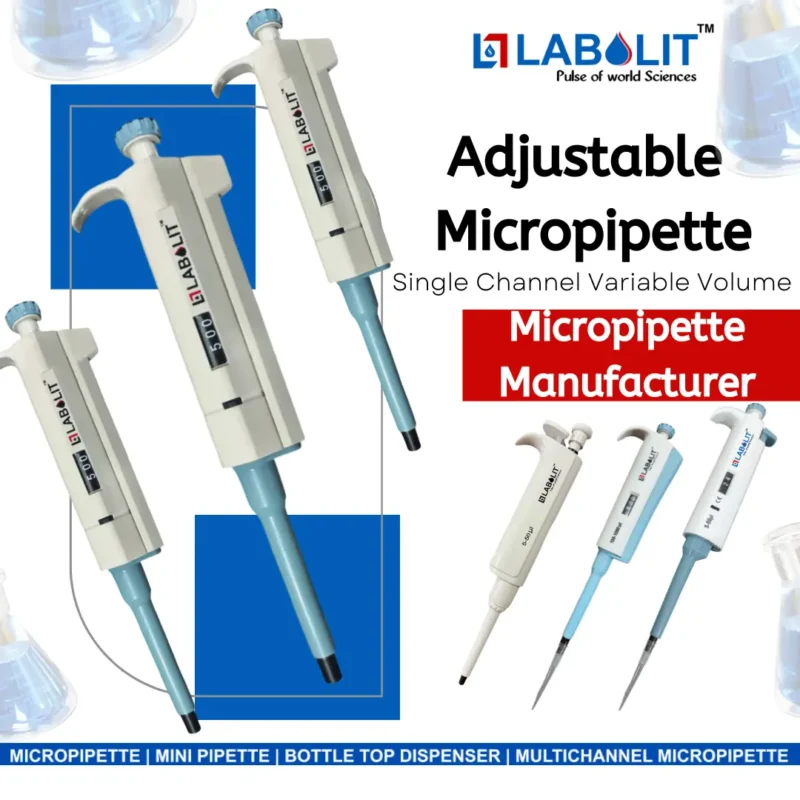
Micropipettes are one of the most important laboratory instruments used in scientific research, medical testing, pharmaceutical industries, biotechnology laboratories, diagnostic centers, educational institutes, and industrial laboratories. These precision instruments are specially designed to measure and transfer extremely small quantities of liquid accurately and repeatedly.
Whether you are working in microbiology, chemistry, molecular biology, pathology, PCR testing, pharmaceutical research, or academic laboratories, a micropipette becomes an essential tool for accurate liquid handling.
In modern laboratories, even a tiny error in liquid dispensing can affect the final result of an experiment. That is why laboratories rely heavily on high-quality micropipettes for precision, repeatability, and reliability.
In this complete in-depth guide, you will learn:
- What is a micropipette?
- Working principle of micropipettes
- Types of micropipettes
- Uses and applications
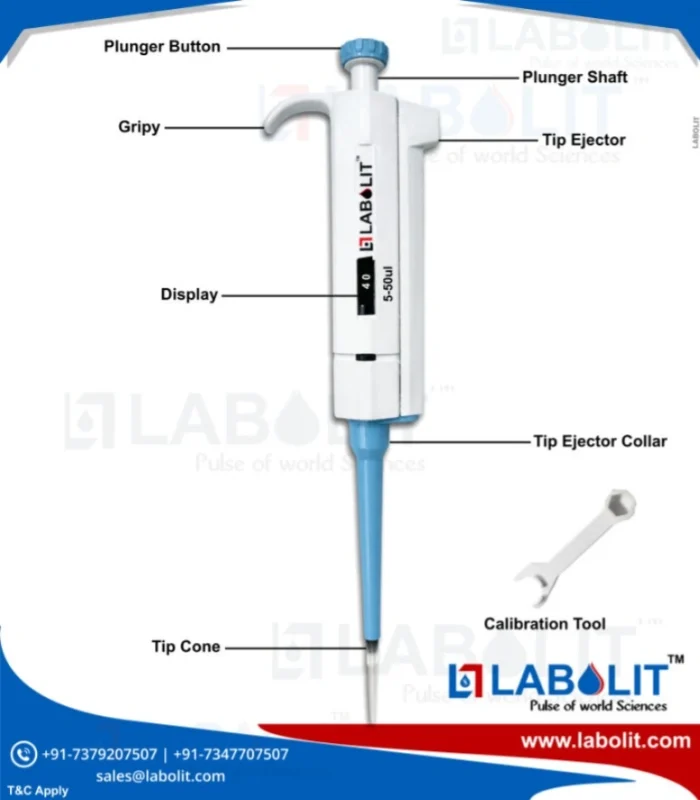
- Parts and components
- Proper handling techniques
- Calibration and maintenance
- Common mistakes to avoid
- How to choose the best micropipette
- Why LABOLIT micropipettes are trusted by laboratories
What is a Micropipette?

A micropipette is a laboratory instrument used for measuring and transferring very small volumes of liquids with high precision and accuracy. Micropipettes are generally used to dispense liquid volumes ranging from 0.1 µL to 10000 µL.
The instrument works using an air displacement mechanism where liquid is aspirated and dispensed through disposable pipette tips.
Micropipettes are widely used in:
- Diagnostic laboratories
- Research laboratories
- Biotechnology industries
- Pharmaceutical companies
- Medical testing centers
- Educational institutions
- Food testing laboratories
- Chemical laboratories
- Pathology laboratories
- PCR and molecular biology labs
Due to their ability to deliver highly accurate liquid volumes, micropipettes have become essential tools in laboratory operations.
History of Micropipettes
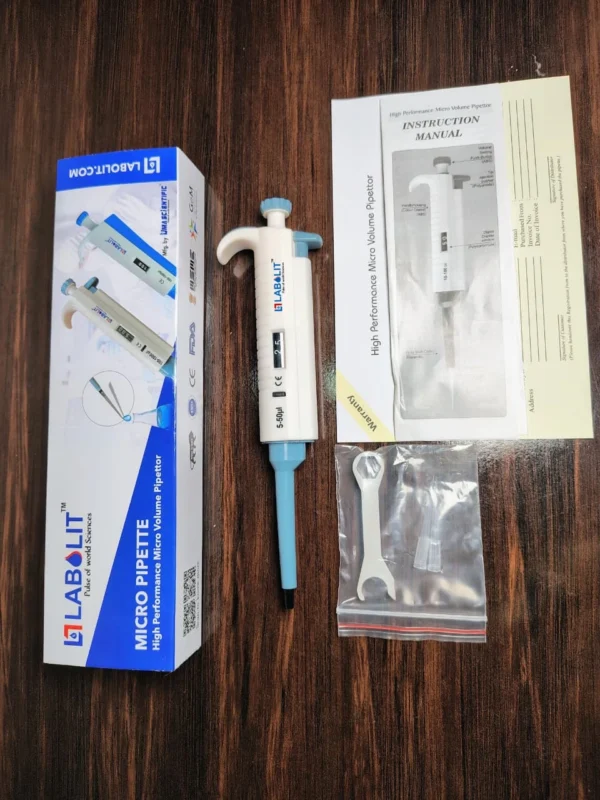
Before modern micropipettes were introduced, laboratories used glass pipettes for liquid handling. These methods were time-consuming and less accurate. With advancements in laboratory technology, adjustable micropipettes were developed to improve precision and user convenience.
Today, digital and ergonomic micropipettes are available with advanced calibration systems and improved handling comfort.
Modern micropipettes provide:
- Better precision
- Faster liquid transfer
- Reduced human error
- Comfortable operation
- High repeatability
- Enhanced laboratory productivity
Working Principle of a Micropipette
Micropipettes generally work on the air displacement principle.
Inside the micropipette, a piston moves up and down using spring mechanisms. When the plunger is pressed and released:
- Air inside the shaft moves
- Vacuum pressure is created
- Liquid is aspirated into the tip
- Pressing the plunger again dispenses the liquid
This system enables highly accurate transfer of small liquid volumes.
Steps Involved in Micropipette Operation
1. Setting Volume
The desired volume is selected using the adjustment knob.
2. Attaching Pipette Tip
A compatible disposable tip is attached firmly.
3. Aspirating Liquid
The plunger is pressed to the first stop and released slowly after immersing the tip into the liquid.
4. Dispensing Liquid
The liquid is transferred by pressing the plunger to the second stop.
5. Ejecting Tip
Used tips are safely discarded using the tip ejector.
Main Parts of a Micropipette
Understanding micropipette components is important for proper usage and maintenance.
1. Plunger Button
Used to aspirate and dispense liquid.
2. Volume Adjustment Knob
Allows users to set the desired liquid volume.
3. Volume Display Window
Displays the selected volume.
4. Tip Cone
Holds disposable pipette tips securely.
5. Shaft
Connects the internal piston mechanism.
6. Tip Ejector
Removes used pipette tips hygienically.
7. Spring and Piston System
Controls liquid aspiration and dispensing.
Types of Micropipettes
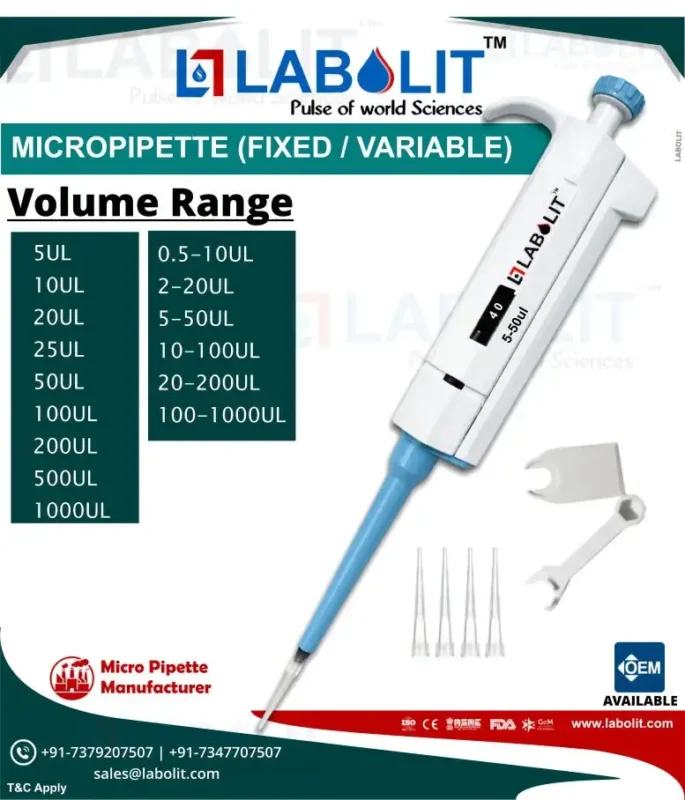
1. Fixed Volume Micropipette
Fixed volume micropipettes dispense only one specific volume.
Features
- High precision
- Reduced user error
- Simple operation
- Ideal for repetitive tasks
Applications
- Diagnostic laboratories
- Routine testing
- Educational laboratories
- Quality control labs
Common Fixed Volumes
- 10 µL
- 20 µL
- 100 µL
- 200 µL
- 1000 µL
2. Variable Volume Micropipette
Variable micropipettes allow users to adjust liquid volume within a specified range.
Common Variable Ranges
- 0.1–2 µL
- 0.5–10 µL
- 2–20 µL
- 10–100 µL
- 20–200 µL
- 100–1000 µL
- 1000–5000 µL
Advantages
- Flexible operation
- Multiple volume handling
- Cost-effective
- Suitable for research applications
Applications
- Molecular biology
- PCR testing
- Biotechnology research
- Pharmaceutical laboratories
3. Single Channel Micropipette
Single channel micropipettes transfer liquid through one tip at a time.
Advantages
- High precision
- Easy handling
- Ideal for routine lab work
Applications
- Sample preparation
- Chemical analysis
- Medical testing
4. Multi Channel Micropipette
Multi channel micropipettes contain multiple channels, usually 8 or 12.
Advantages
- Faster operation
- High productivity
- Time saving
Applications
- ELISA testing
- PCR plates
- Microplate filling
- High-throughput laboratories
5. Electronic Micropipette
Electronic micropipettes use motorized systems for liquid handling.
Features
- Digital control
- Improved accuracy
- Reduced hand fatigue
- Automatic dispensing
Applications
- Advanced research labs
- Pharmaceutical industries
- Automation laboratories
6. Mechanical Micropipette
Mechanical micropipettes are manually operated and widely used in laboratories.
Features
- Affordable
- Durable
- Easy maintenance
- Reliable performance
Micropipette Volume Ranges
Different micropipettes are designed for different liquid volumes.
| Micropipette Range | Application |
|---|---|
| 0.1–2 µL | DNA/RNA work |
| 0.5–10 µL | PCR applications |
| 2–20 µL | Molecular biology |
| 20–200 µL | General laboratory use |
| 100–1000 µL | Sample preparation |
| 1000–5000 µL | Bulk liquid transfer |
Selecting the correct volume range is essential for maintaining accuracy.
Uses of Micropipettes
Micropipettes are used in almost every scientific laboratory.
1. Molecular Biology
Used for DNA extraction, PCR preparation, and RNA analysis.
2. Pharmaceutical Industry
Used for formulation testing, research, and quality control.
3. Diagnostic Laboratories
Used in pathology and blood sample testing.
4. Biotechnology Research
Essential for genetic engineering and microbiology.
5. Chemical Laboratories
Used for chemical sample preparation and titration.
6. Food Testing Laboratories
Used for food quality and contamination analysis.
7. Educational Institutions
Used in practical laboratory training.
Importance of Micropipette Accuracy
Accuracy and precision are critical in laboratory experiments.
Even small volume errors can lead to:
- Incorrect results
- Failed experiments
- Wasted samples
- Financial losses
- Reduced laboratory reliability
High-quality micropipettes ensure:
- Reliable measurements
- Repeatable results
- Better laboratory efficiency
- Reduced contamination
Difference Between Accuracy and Precision
Accuracy
Refers to how close the dispensed volume is to the true value.
Precision
Refers to repeatability of measurements.
A good micropipette should provide both accuracy and precision.
How to Use a Micropipette Correctly
Proper handling improves performance and increases instrument life.
Step 1: Select Correct Volume Range
Never use a micropipette outside its specified range.
Step 2: Attach Tip Properly
Use compatible high-quality tips.
Step 3: Pre-Wet the Tip
Aspirate and dispense liquid once before actual use.
Step 4: Maintain Correct Angle
Hold the pipette vertically while aspirating.
Step 5: Immerse Tip Properly
Do not immerse too deeply.
Step 6: Release Plunger Slowly
Fast release may create bubbles.
Step 7: Dispense Smoothly
Touch tip against container wall for complete dispensing.
Common Micropipetting Techniques
Forward Pipetting
Most commonly used technique for aqueous solutions.
Reverse Pipetting
Used for viscous or foamy liquids.
Repetitive Dispensing
Used for multiple sample dispensing.
Common Micropipette Errors
Many laboratories face accuracy issues due to improper handling.
1. Using Wrong Volume Range
Can reduce accuracy significantly.
2. Fast Plunger Release
Creates air bubbles.
3. Poor Quality Tips
May cause leakage and inconsistent dispensing.
4. Holding Pipette Incorrectly
Incorrect angle affects aspiration.
5. Reusing Disposable Tips
May cause contamination.
6. Lack of Calibration
Leads to inaccurate results.
Micropipette Calibration
Calibration ensures the micropipette dispenses correct liquid volumes.
Why Calibration is Important
- Maintains accuracy
- Ensures compliance
- Reduces errors
- Improves reliability
Calibration Frequency
- Every 3 to 6 months
- Depending on usage frequency
Calibration Methods
- Gravimetric method
- Electronic calibration systems
How to Maintain a Micropipette
Proper maintenance increases instrument life and accuracy.
Daily Maintenance
- Clean exterior surface
- Remove contaminated tips
- Store vertically
Weekly Maintenance
- Inspect tip cone
- Check piston movement
- Verify volume setting
Periodic Maintenance
- Lubricate piston
- Replace seals and O-rings
- Perform calibration
Cleaning a Micropipette
Cleaning is important for hygiene and contamination prevention.
Basic Cleaning Process
- Remove tip ejector
- Disassemble lower section
- Clean with alcohol
- Dry completely
- Reassemble carefully
Avoid harsh chemicals that may damage internal components.
Proper Storage of Micropipettes
Correct storage prevents damage and contamination.
Storage Tips
- Use pipette stands
- Store vertically
- Avoid humid environments
- Remove tips after use
- Keep away from dust
Micropipette Tips
Pipette tips are essential accessories used with micropipettes.
Types of Tips
Standard Tips
Used for general laboratory work.
Filter Tips
Prevent aerosol contamination.
Low Retention Tips
Used for viscous liquids.
Sterile Tips
Used in microbiology and PCR work.
Choosing the Right Micropipette
Selecting the correct micropipette depends on several factors.
1. Volume Range
Choose according to application needs.
2. Accuracy Requirement
Research laboratories require higher precision.
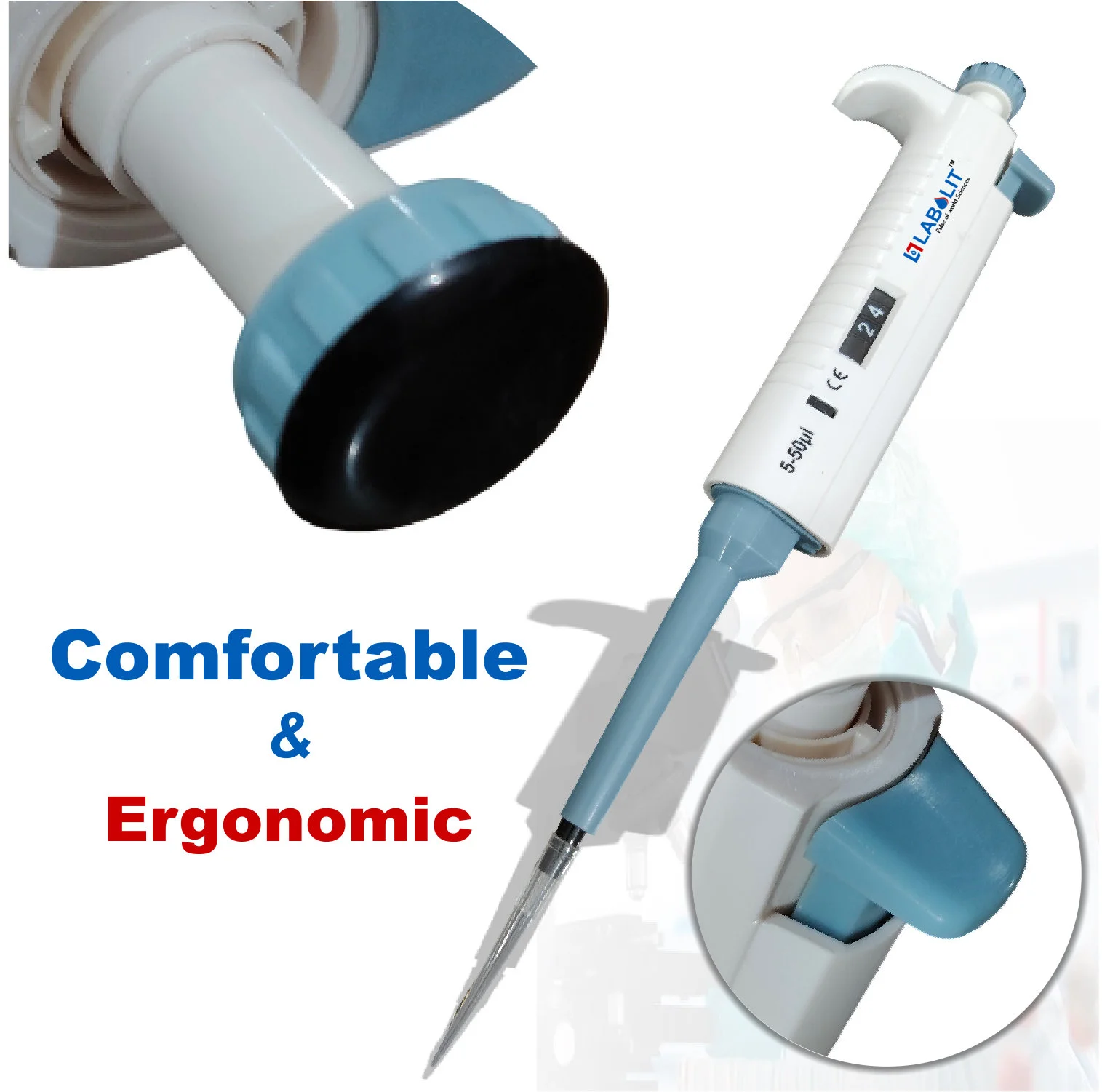
3. Ergonomic Design
Comfortable design reduces hand fatigue.
4. Calibration Support
Ensure easy calibration availability.
5. Build Quality
Durable construction improves lifespan.
6. Service Availability
Reliable after-sales support is important.
Features of a High-Quality Micropipette
A premium micropipette should include:
- High accuracy
- Smooth plunger movement
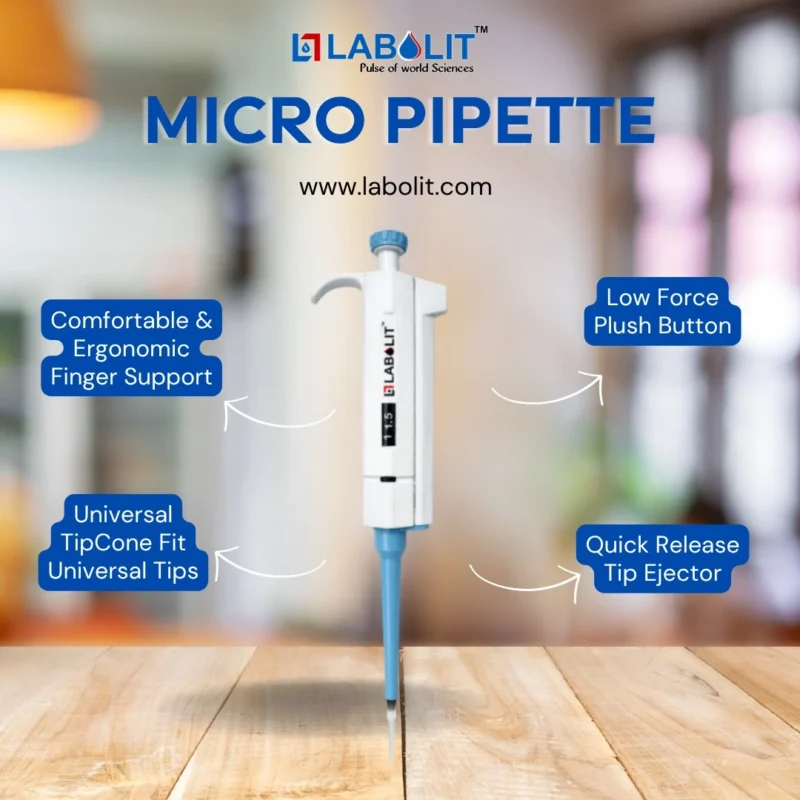
- Ergonomic grip
- Chemical resistance
- Easy calibration
- Strong durability
- Clear volume display
- Leak-proof design
Micropipettes in PCR Laboratories
PCR applications require extremely accurate liquid transfer.
Micropipettes used in PCR laboratories must provide:
- High precision
- Contamination-free operation
- Sterile handling
- Repeatable dispensing
Filter tips are commonly used in PCR applications to prevent contamination.
Micropipettes in Pharmaceutical Industries
Pharmaceutical industries rely heavily on micropipettes for:
- Drug formulation
- Quality control
- Research and development
- Chemical analysis
- Sample preparation
Accurate dispensing is critical for pharmaceutical manufacturing and testing.
Micropipettes in Biotechnology
Biotechnology laboratories use micropipettes for:
- Cell culture work
- DNA analysis
- Protein studies
- Genetic engineering
- Molecular biology experiments
Difference Between Pipette and Micropipette
| Pipette | Micropipette |
|---|---|
| Used for larger volumes | Used for micro volumes |
| Often glass based | Mostly mechanical/electronic |
| Lower precision | High precision |
| Manual operation | Advanced liquid handling |
| Basic laboratory use | Research and diagnostics |
Advantages of Micropipettes
High Accuracy
Provides precise liquid transfer.
Better Repeatability
Ensures consistent results.
Easy Operation
Simple and user-friendly design.
Reduced Contamination
Disposable tips improve hygiene.
Time Saving
Improves laboratory efficiency.
Wide Volume Range
Suitable for multiple applications.
Limitations of Micropipettes
Despite many advantages, micropipettes also have some limitations.
- Require regular calibration
- Sensitive to handling errors
- Disposable tip dependency
- Mechanical wear over time
However, proper maintenance minimizes these issues.
Safety Tips While Using Micropipettes
Laboratory safety is very important.
Follow These Safety Measures
- Wear gloves
- Use sterile tips
- Avoid mouth pipetting
- Discard contaminated tips properly
- Clean spills immediately
- Store safely after use
Future of Micropipette Technology
Modern laboratories are moving toward automation and digital liquid handling systems.
Future micropipette technologies may include:
- Smart digital calibration
- Bluetooth connectivity
- Automated liquid handling
- AI-based monitoring
- Improved ergonomic designs
These innovations will improve laboratory productivity and precision.
Why Laboratories Prefer LABOLIT Micropipettes

LABOLIT is one of the trusted micropipette manufacturers and suppliers offering high-quality laboratory instruments for research, diagnostics, pharmaceutical, and industrial laboratories.
Features of LABOLIT Micropipettes
- High precision performance
- Adjustable and fixed volume models
- Ergonomic design
- Smooth plunger operation
- Durable construction
- Wide volume ranges available
- Reliable laboratory performance
- Affordable pricing
- Suitable for research and diagnostics
Available Volume Ranges
- 0.1–2 µL
- 0.5–10 µL
- 2–20 µL
- 10–100 µL
- 20–200 µL
- 100–1000 µL
- 1000–5000 µL
- 5000–10000 µL
Available Models
- Single Channel Micropipettes
- Multi Channel Micropipettes
- Fixed Volume Micropipettes
- Variable Volume Micropipettes
How to Increase Micropipette Life
Proper care increases operational lifespan.
Best Practices
- Use compatible tips
- Avoid dropping the pipette
- Store on pipette stand
- Perform regular calibration
- Clean after use
- Avoid chemical exposure
Signs Your Micropipette Needs Service
A micropipette may require servicing if you notice:
- Inconsistent dispensing
- Leakage
- Stiff plunger movement
- Volume inaccuracies
- Loose tip fitting
- Internal contamination
Immediate servicing helps maintain laboratory accuracy.
Frequently Asked Questions (FAQs)
What is a micropipette used for?
A micropipette is used for accurately measuring and transferring small liquid volumes in laboratories.
What is the difference between fixed and variable micropipette?
Fixed micropipettes dispense one fixed volume while variable micropipettes allow adjustable volume selection.
How accurate is a micropipette?
High-quality micropipettes provide extremely accurate and repeatable liquid dispensing.
How often should a micropipette be calibrated?
Micropipettes should generally be calibrated every 3–6 months depending on usage.
Which industries use micropipettes?
Micropipettes are used in diagnostics, pharmaceuticals, biotechnology, education, food testing, and research laboratories.
Why are filter tips used?
Filter tips help prevent aerosol contamination and improve sample protection.
Can micropipettes be repaired?
Yes, micropipettes can be serviced and repaired through calibration and maintenance.
Conclusion
Micropipettes are among the most essential instruments used in modern laboratories. Their ability to deliver precise and accurate liquid handling makes them indispensable in scientific research, diagnostics, pharmaceuticals, biotechnology, and industrial applications.
Understanding micropipette types, working principles, handling methods, calibration, and maintenance is extremely important for obtaining reliable laboratory results.
Whether you are running a research laboratory, pathology center, educational institution, pharmaceutical company, or industrial testing facility, investing in a high-quality micropipette ensures accuracy, efficiency, and long-term performance.
LABOLIT offers a wide range of premium-quality micropipettes designed for professional laboratory use with high precision, ergonomic handling, and durable construction.
Contact LABOLIT
Sales: +91 7347707507, +91 7379207507
Purchase: +91 7348107507
Complaint: +91 7408107507
Email: sales.labolit@gmail.com
Email: sales.umascientific@gmail.com
Website: www.labolit.com
SEO Keywords
What is a micropipette, micropipette uses, types of micropipette, laboratory micropipette, micropipette manufacturer in India, adjustable micropipette, fixed volume micropipette, buy micropipette online, single channel micropipette, multi channel micropipette, best micropipette brand, research laboratory micropipette, PCR micropipette, pipette handling guide, micropipette calibration, laboratory equipment manufacturer, micropipette supplier India, scientific instruments India, biotechnology laboratory equipment, pharmaceutical laboratory equipment