What is µAir Technology in Air Displacement Pipettes?


If you have worked in a diagnostic, research, pharmaceutical, biotechnology, or biochemistry laboratory, you have almost certainly used an air displacement pipette. These pipettes are among the most essential liquid handling instruments in modern laboratories due to their versatility, ease of use, and cost-effectiveness.
At LABOLIT, we continuously innovate to improve liquid handling accuracy and precision. One such advancement is µAir Technology, designed to minimize dead air space in air displacement pipettes and deliver superior performance, even at very low volumes.
In this blog, you will learn:
- What an air displacement pipette is
- How it differs from a positive displacement pipette
- Why dead air space affects accuracy
- How LABOLIT µAir Technology improves precision and reliability
What is an Air Displacement Pipette?

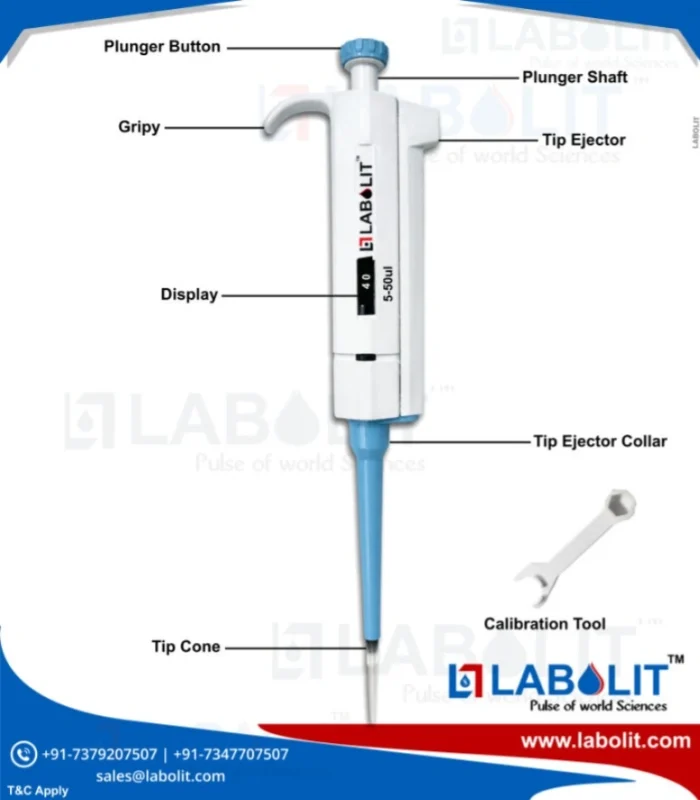
An air displacement pipette, also known as a piston-driven pipette, operates using an air cushion (dead air volume) between the piston and the aspirated liquid.
How it works:
- When the plunger is pressed, the piston moves downward, expelling air.
- When the plunger is released, a vacuum is created.
- This vacuum draws liquid into the pipette tip.
- During dispensing, the compressed air pushes the liquid out of the tip.
The air cushion separates the piston from the liquid, which makes these pipettes ideal for routine laboratory applications involving aqueous solutions.
Air Displacement vs Positive Displacement Pipettes
Although both pipettes use piston movement, the key difference lies in the presence or absence of an air cushion.
Positive Displacement Pipettes:
- No air cushion
- The piston comes into direct contact with the liquid
- Highly accurate for viscous, volatile, or corrosive liquids
Air Displacement Pipettes:
- Air cushion present between piston and liquid
- More versatile and economical
- Best suited for general laboratory use
Key Differences Between Air Displacement and Positive Displacement Pipettes
| S. No | Air Displacement Pipette | Positive Displacement Pipette |
|---|---|---|
| 1 | Air cushion present between piston and liquid | No air cushion; piston contacts liquid |
| 2 | Accuracy affected by liquid properties | Liquid properties do not affect accuracy |
| 3 | Piston moves inside a cylinder | Piston moves inside a capillary |
| 4 | Suitable for aqueous & routine samples | Ideal for viscous, volatile & hazardous samples |
| 5 | Piston integrated in pipette body | Piston integrated into disposable tip |
| 6 | Requires blow-out step | No blow-out step required |
| 7 | Risk of contamination possible | No cross-contamination |
| 8 | Cost-effective and easy tip replacement | Tips are expensive |
| 9 | Highly accurate | More precise |
Why Does Dead Air Space Reduce Accuracy?
The main limitation of air displacement pipettes is dead air space, which affects how efficiently piston force is transferred to the liquid.
Air can:
- Expand or contract with temperature
- Compress unevenly
- Absorb part of the piston force
As a result, very small volumes are more prone to pipetting errors.
There are two major dead air zones in conventional air displacement pipettes:
1. Dead Air Between the Piston and Tip Cone
A large air gap exists between the piston and the tip cone in standard micropipettes. This unused air volume reduces accuracy, especially at low volumes.
LABOLIT Solution:
LABOLIT micropipettes are engineered with:
- Optimized tip cone length
- Reduced internal diameter (ID)
- Precision alignment between piston and tip cone
This design significantly reduces unnecessary air space, improving accuracy and repeatability.
2. Dead Air Between the Piston and Liquid

Additional dead air exists inside the pipette tip itself.
Best Practice:
Always use the smallest suitable volume pipette for your application.
Example:
- For 1 µL volume → Use a 2–5 µL pipette
- Avoid using a 20 µL pipette for very small volumes
This reduces volumetric error and improves reproducibility.
Advantages of Minimizing Dead Air Space
Reducing dead air space offers several key benefits:
✔ Higher precision and accuracy
✔ Better performance at low volumes
✔ Smooth and controlled dispensing
✔ Reduced liquid retention inside the tip
✔ Less dependency on costly low-retention tips
What is µAir Technology by LABOLIT?
µAir Technology is LABOLIT’s advanced design approach focused on minimizing dead air space in air displacement pipettes.
Key Features of LABOLIT µAir Technology:
- Optimized tip cone geometry
- Reduced internal air volume
- Improved piston-to-tip alignment
- Enhanced air compression efficiency
For lower-volume pipettes, LABOLIT integrates a polypropylene sleeve inside the tip cone.
This sleeve:
- Reduces the internal diameter
- Compresses excess air
- Improves force transfer from piston to liquid
The result is exceptional accuracy and consistency, even at micro-volumes.
Why Choose LABOLIT Air Displacement Pipettes?
LABOLIT pipettes are designed for laboratories that demand precision, durability, and reliability.
LABOLIT Advantages:
- High-precision µAir Technology
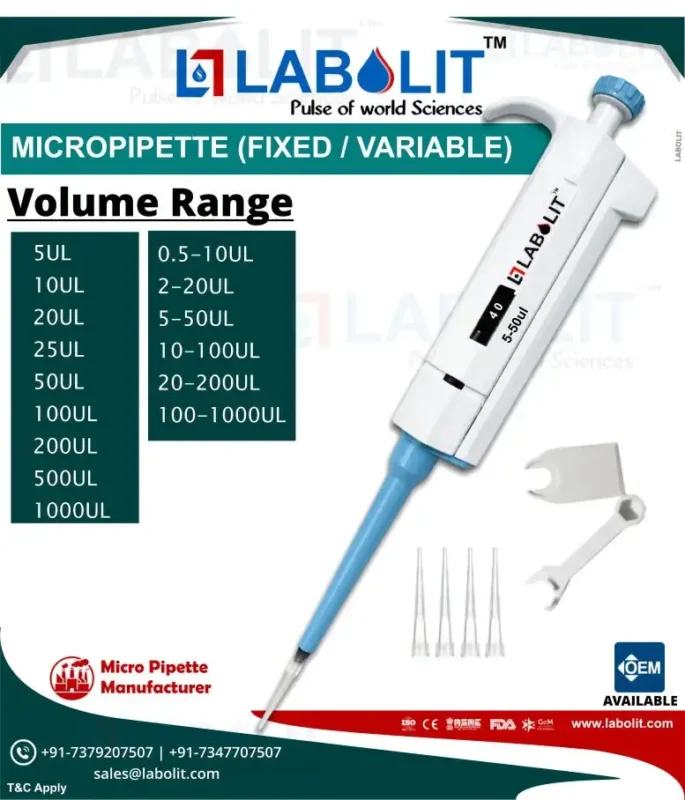
- Fixed & variable volume options
- Single-channel & multi-channel models
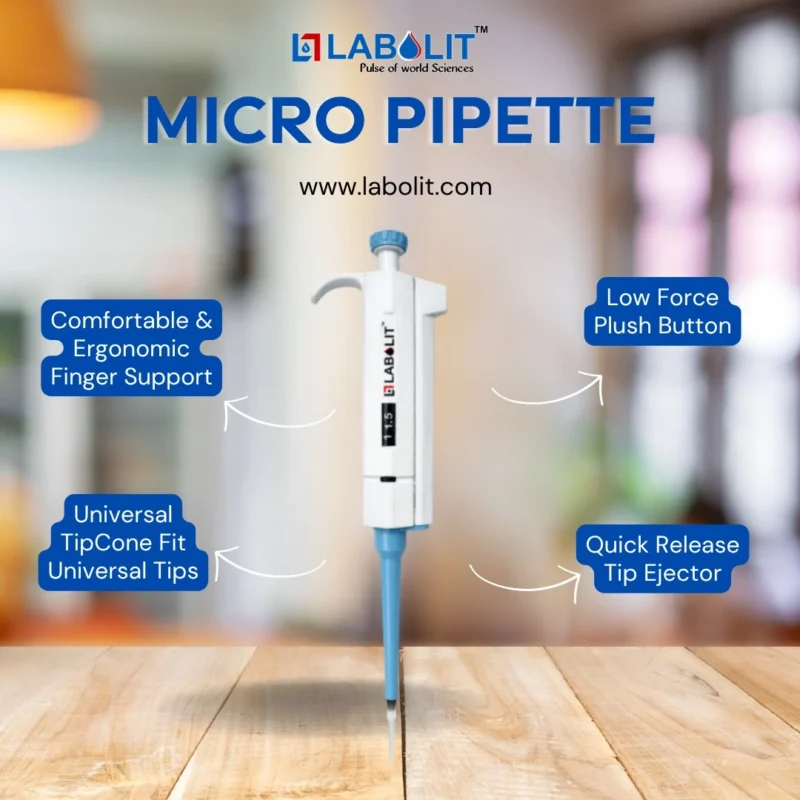
- Ergonomic design for long lab hours
- Made for research, diagnostics & pharma labs
Conclusion
Air displacement pipettes remain the backbone of routine laboratory liquid handling. However, accuracy depends heavily on how effectively dead air space is managed.
With µAir Technology, LABOLIT has redefined air displacement pipette performance by:
- Minimizing dead air zones
- Enhancing precision at low volumes
- Delivering reliable and repeatable results
If you are looking for high-quality air displacement micropipettes made for modern laboratories, LABOLIT is the right choice.